Facial hair is completely normal, but for some women it becomes noticeably darker, coarser or faster-growing than they would like. The result can be an exhausting cycle: pluck in the morning, check again in the evening, repeat tomorrow.
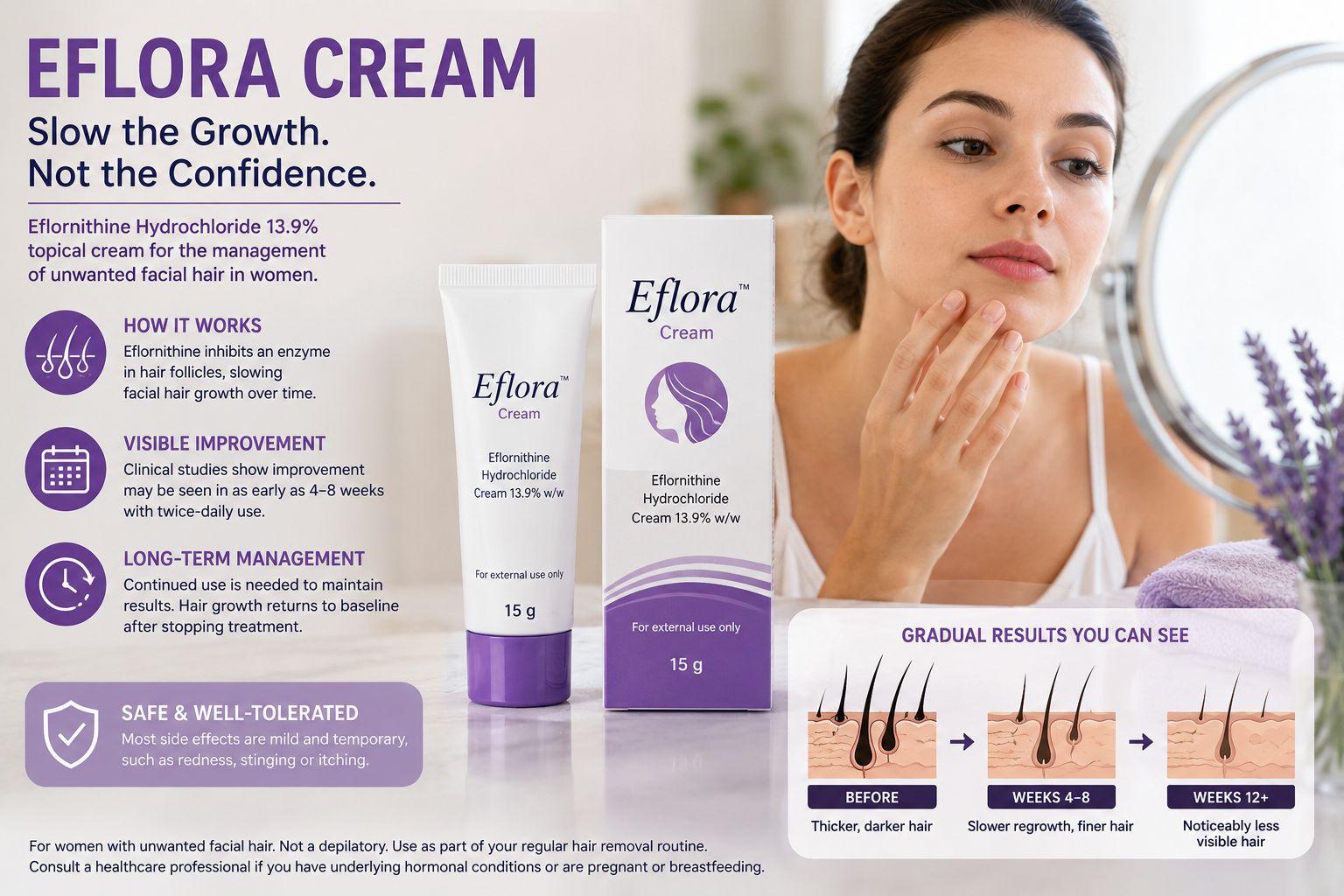
Shaving, waxing, threading and tweezing all solve essentially the same problem—they remove hair that has already grown. Eflora cream approaches the problem from a different direction. Instead of pulling out or dissolving existing hair, its active ingredient, eflornithine hydrochloride 13.9%, interferes with a biological process inside the hair follicle and gradually slows the rate at which facial hair grows.
That distinction makes eflornithine one of the more unusual treatments available for unwanted facial hair in women.
The current Eflora/Elyn product listing contains eflornithine hydrochloride 13.9% in a 15 g topical cream and positions the products as alternatives for women familiar with the prescription medicine Vaniqa.
But there is one important fact to understand from the beginning:
Eflornithine is not a depilatory cream, and it does not permanently destroy hair follicles.
Its value lies in making unwanted facial hair progressively easier to manage.
Why Does Unwanted Facial Hair Develop?
Hair follicles throughout the body respond differently to hormones, genetics and age.
Some women naturally grow more terminal facial hair than others. In other cases, increased facial hair—known medically as hirsutism—may be associated with increased androgen activity.
Possible underlying factors can include:
- polycystic ovary syndrome, or PCOS;
- hormonal changes;
- certain medications;
- menopause and age-related hormonal shifts;
- inherited sensitivity of hair follicles to androgens;
- less commonly, endocrine disorders affecting androgen production.
Sometimes no identifiable hormonal abnormality is found at all.
This matters because treating the visible hair and investigating why it is growing are two different tasks.
A few new chin hairs developing gradually over many years may be very different medically from facial hair that suddenly becomes dense and coarse while menstrual cycles also become irregular.
Rapidly progressive hirsutism or unwanted hair accompanied by other signs of androgen excess deserves medical evaluation rather than simply cosmetic treatment.
What Makes Eflora Cream Different?
To appreciate how eflornithine works, it helps to understand that hair growth requires continuous biochemical activity inside the follicle.
One enzyme involved in that process is ornithine decarboxylase, usually abbreviated ODC.
ODC participates in the production of compounds called polyamines, which are important for rapidly dividing cells—including cells involved in hair growth.
Eflornithine inhibits ornithine decarboxylase activity. The result is not instant disappearance of existing hairs. Instead, follicular activity slows, reducing the rate at which new hair becomes visible.
The Endocrine Society describes topical eflornithine as a treatment that reduces the rate of hair growth rather than physically removing hair.
That creates an important practical difference between eflornithine and conventional hair-removal products.
A depilatory dissolves visible hair.
A razor cuts it.
Waxing or tweezing pulls it from the follicle.
Laser treatment attempts to damage hair-producing structures.
Eflora cream slows the biological growth process itself.
What Does the Clinical Evidence Show?
Eflornithine is not simply a cosmetic ingredient supported by anecdotal before-and-after photographs.
The 13.9% topical formulation has been evaluated in randomized clinical studies.
Two pivotal double-blind trials included 594 women with unwanted facial hair. Participants applied either eflornithine hydrochloride 13.9% cream or the vehicle cream twice daily for up to 24 weeks.
At 24 weeks, approximately 32% of women using eflornithine achieved marked improvement or better, compared with about 8% using the vehicle cream.
Another 26% of eflornithine-treated participants were rated as improved, although they did not reach the study’s threshold for “marked improvement.”
Perhaps more useful for consumers is the timeline.
Clinical improvement became consistently apparent at around eight weeks, and patient-observable differences were reported during this period as well.
So someone starting eflornithine should not expect a dramatically smoother face after several days.
This is a treatment measured in weeks, not hours.
Why You Still Need to Remove Hair
One of the biggest misconceptions surrounding eflora cream is that applying it makes current facial hair fall out.
It does not.
Official eflornithine prescribing information specifically states that the medicine is not a depilatory. Users generally continue their existing hair-removal method while the cream gradually reduces regrowth.
That means shaving, threading, waxing, plucking or another suitable method can still be used.
Over time, successful treatment may mean that hair appears more slowly and removal needs to happen less frequently.
For someone who currently checks her chin every morning for new coarse hairs, even extending the interval between removal sessions can make a meaningful practical difference.
This is one reason quality-of-life studies of eflornithine are interesting: unwanted facial hair is not merely a cosmetic measurement. It can influence the amount of time spent grooming, social confidence and daily routines.
When Should Results Appear?
Patience is probably the most important requirement.
Official prescribing information reports that improvement may become noticeable after approximately four to eight weeks, although some users require longer.
If treatment works, continued application is necessary to maintain the effect.
This leads to another important point:
Eflornithine is not permanent hair removal.
Clinical studies found that facial-hair growth generally moved back toward pretreatment levels within approximately eight weeks after treatment was stopped.
This is very different from the promise suggested by phrases such as “permanent hair-removal cream.”
Eflornithine is better understood as long-term hair-growth management.
While treatment continues, follicular growth is suppressed. Once treatment stops, that suppression gradually disappears.
How Is Eflornithine Cream Normally Used?
Official instructions for topical eflornithine 13.9% generally involve applying a thin layer twice daily, with applications at least eight hours apart.
The medicine is intended for affected areas of the face and adjacent areas underneath the chin.
Users typically continue their normal hair-removal method, but eflornithine should be applied after the skin has had a few minutes to recover following hair removal.
The treated area should not be washed for at least four hours after application.
Once the cream has dried, cosmetics, moisturizer or sunscreen can generally be applied.
The current OKDERMO listing offers Eflora and Elyn in a 15 g format containing the same listed active ingredient and concentration. Consumers researching availability can view Eflora/Elyn on OKDERMO.
As with other medicated topical products, purchase and prescription requirements depend on the country where the user lives.
Why Eflornithine and Laser Can Complement Each Other
An interesting feature of eflornithine is that it does not necessarily have to compete with other hair-reduction techniques.
The Endocrine Society’s clinical guideline specifically discusses adding topical eflornithine for women who want a faster response during photoepilation treatment.
Randomized research has also investigated eflornithine alongside laser or intense-pulsed-light procedures.
The logic is straightforward.
Laser and IPL target hair through light-based energy, while eflornithine works through a completely different biochemical pathway. Combining approaches may therefore help reduce visible regrowth during the treatment process.
This can be especially relevant because laser hair reduction usually requires multiple sessions and does not instantaneously stop all hairs from returning.
Eflornithine can also be useful where permanent procedural treatments are unsuitable or simply not desired.
What About Blonde, Grey or White Facial Hair?
This is another area where the mechanism becomes interesting.
Many light-based hair-removal technologies work best when the hair contains enough melanin to absorb the laser energy.
That is why blonde, grey and white hairs can be difficult targets for conventional laser hair removal.
Eflornithine does not depend on the color of the hair in the same way. It acts on follicular biochemical activity rather than targeting pigment with light.
For women with light-colored unwanted facial hair, this difference can make topical therapy particularly relevant as one of the available management options.
Electrolysis is another option frequently considered for hairs that respond poorly to photoepilation.
Can Eflora Cream Treat PCOS?
This question requires a careful distinction.
Eflornithine can reduce unwanted facial-hair growth in a woman who has PCOS, but it does not treat the underlying polycystic ovary syndrome itself.
PCOS can involve hormonal, reproductive and metabolic changes, including increased androgen activity.
Eflornithine works locally on the hair follicle.
A clinician treating hirsutism associated with PCOS may therefore consider several different strategies depending on the patient, including hormonal therapy, anti-androgen treatment, lifestyle interventions where appropriate, direct hair-removal procedures and topical eflornithine.
The facial cream addresses the hair-growth symptom rather than correcting the hormonal condition responsible for it.
Side Effects Are Usually Local
Because eflornithine is applied to the skin and systemic absorption is very low under normal conditions of use, most treatment-related problems are dermatological rather than whole-body effects.
Reported reactions can include:
- temporary stinging;
- burning;
- tingling;
- redness;
- itching;
- dryness;
Applying the cream to damaged or freshly irritated skin may increase discomfort.
If persistent irritation develops, official prescribing information advises reducing application frequency temporarily and discontinuing treatment if the problem continues.
The cream is for external use and should be kept away from the eyes and the inside of the nose and mouth.
Pregnancy and Breastfeeding Require Extra Caution
Pregnancy is an area where absence of evidence matters.
Adequate controlled clinical studies of topical eflornithine in pregnant women are lacking. Official product information therefore advises discussing pregnancy or plans for pregnancy with a healthcare professional before treatment.
It is also unknown whether topically administered eflornithine passes into human breast milk.
For breastfeeding women, professional medical advice is therefore appropriate before use.
Safety and effectiveness have not been established for children under 12 years of age.
The Psychological Side of Facial Hair Is Easy to Underestimate
Clinical discussions of hirsutism sometimes focus heavily on hormone levels and hair counts.
But unwanted facial hair can have an outsized impact on everyday life.
A woman may spend only ten minutes tweezing each morning, yet think about facial hair for much longer: checking it under different lighting, avoiding close photographs, worrying whether someone else can see stubble, or planning social events around waxing appointments.
Research involving women treated with eflornithine found significant reductions in how bothered participants felt by their unwanted facial hair and by the time required to remove or conceal it.
That does not mean facial hair is inherently a medical problem.
Treatment is worthwhile when the person experiencing it considers it a problem.
That patient-centered distinction is important.
Eflora, Elyn and Vaniqa: Understanding the Names
Consumers researching eflornithine encounter several brand names.
Vaniqa is the best-known original brand associated with topical eflornithine.
Eflora and Elyn are other products marketed with eflornithine hydrochloride 13.9% and positioned as alternatives in markets where Vaniqa is difficult to obtain.
What matters most when comparing products is not simply the brand printed on the tube but the active ingredient, listed concentration, manufacturer, regulatory status and legitimacy of the supply chain.
Consumers should avoid assuming that every cream advertised online as a “Vaniqa alternative” necessarily contains authentic eflornithine at the correct concentration.
The Bottom Line
Eflora cream occupies an unusual middle ground between medication and cosmetic hair management.
It does not shave, dissolve or pull out hair. It does not destroy follicles permanently. And it does not treat every hormonal condition responsible for excessive facial hair.
Instead, eflornithine hydrochloride 13.9% works by interfering with an enzyme involved in follicular activity, gradually slowing facial-hair growth.
Clinical trials show that meaningful improvement can occur, but the process requires patience. Initial changes generally appear after several weeks, continued treatment is needed to maintain results, and normal growth tends to return after treatment stops.
For the right user, that may be exactly the advantage.
The objective is not necessarily to eliminate every follicle forever. It may simply be to transform facial-hair management from something that demands attention every day into something considerably less frequent and intrusive.
And for many women dealing with persistent unwanted facial hair, that can be a meaningful improvement in itself.