Key Takeaways
- Put safety and emergency medical care ahead of photographs, paperwork, and insurance calls.
- Call 911 when there are injuries, roadway hazards, significant damage, or uncertainty about what happened.
- Document the scene, damaged gear, witnesses, and medical care as soon as it is safe.
- Keep statements factual, avoid guessing about fault, and read insurance documents before signing.
- Crash-reporting rules, insurance requirements, and filing deadlines differ by state.
Why the First Day Matters
A motorcycle crash can be disorienting, even when it initially seems minor. Adrenaline may mask pain, traffic may create an immediate danger, and damaged gear or a disabled bike can complicate an already stressful situation. Riders dealing with injuries, disputed fault, or insurance questions may later seek guidance from Dimopoulos Injury Law, but the first priority at the scene is always personal safety and medical care.
Motorcyclists have less physical protection than people in enclosed vehicles, and visibility can be a major concern on shared roads. Federal motorcycle safety guidance emphasizes defensive riding, helmet use, roadway awareness, and the responsibility of all road users to watch for motorcycles.
Step One: Get Away From Immediate Danger
If you can move without worsening an injury, get yourself out of active traffic and away from hazards. Watch for passing vehicles, leaking fuel, smoke, fire, unstable vehicles, broken glass, and downed power lines. Do not try to lift a motorcycle or move another injured person if doing so could cause further harm. Moving an injured person may be necessary only when staying put creates a more serious immediate threat, such as fire or oncoming traffic.
If bystanders are present, ask someone to call 911, direct traffic from a safe distance, or help identify the exact location. Never ask anyone to put themselves in traffic to protect the crash scene.
Step Two: Call 911 and Describe the Emergency Clearly
Tell the dispatcher that a motorcycle crash has occurred and provide the road name, direction of travel, nearest intersection, mile marker, or recognizable landmark. Describe any visible injuries, unconscious people, blocked lanes, fuel leaks, fire, or other hazards. Stay on the line until the dispatcher says it is appropriate to disconnect.
Step Three: Check for Injuries Without Guessing
Do not diagnose yourself at the scene. Symptoms can emerge slowly after a collision, especially after a hard impact or fall. Seek urgent help for confusion, fainting, severe headache, repeated vomiting, breathing trouble, heavy bleeding, chest or abdominal pain, numbness, weakness, neck or back pain, suspected fractures, or severe road rash.
A helmet should generally remain on until trained medical personnel assess the rider. Removing it incorrectly can aggravate a possible neck or spinal injury. If breathing is blocked or another immediate emergency exists, follow dispatcher instructions while waiting for responders.
Step Four: Preserve the Scene When It Is Safe
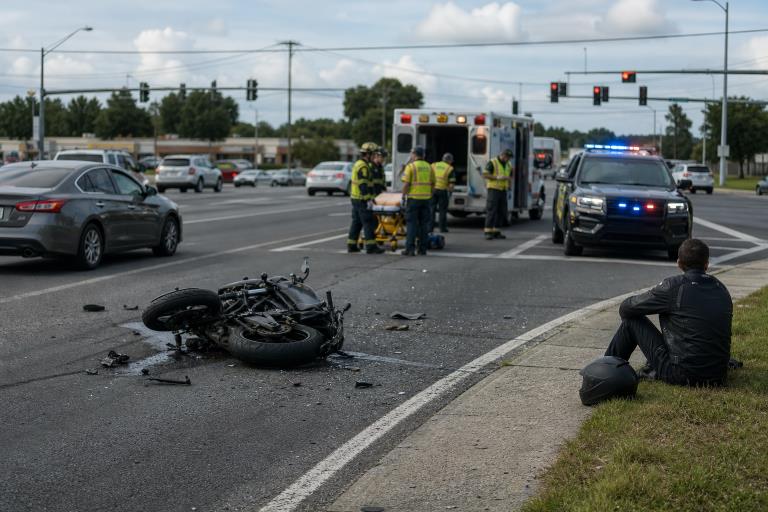
Once emergency needs are addressed, use a phone to make a simple visual record. Start with wide photographs that show the roadway, intersection, traffic controls, lane markings, weather, lighting, construction, debris, and final positions of the vehicles. Then take closer images of vehicle damage, the motorcycle, skid marks, broken parts, and damaged riding gear.
- Save helmet-camera, dashcam, and phone video in more than one location.
- Photograph your helmet, jacket, gloves, boots, luggage, and other damaged property.
- Write down the time, location, weather, and sequence of events while details are fresh.
- Do not interfere with police work or delay treatment to collect evidence.
Step Five: Gather Witness and Driver Information
Exchange required identification and insurance information calmly. If independent witnesses stopped, ask for their full names, phone numbers, or email addresses, and a brief description of what they observed. It can also help to note where each witness was standing or driving. Do not pressure anyone to take sides or argue with the other driver about blame.
Step Six: Cooperate With Police, but Keep Statements Factual
Give officers an honest account of what you observed. Useful statements focus on facts, such as “The vehicle moved into my lane,” “I was traveling straight through the intersection,” or “My left shoulder hurt after the impact.” Avoid speculating about speed, distance, distraction, impairment, or another person’s intentions if you do not know.
Statements like “I must have caused it” or “I am completely fine” can be inaccurate when you are shocked, in pain, or still assessing injuries. Ask for the report number and confirm that your contact details are correct.
Step Seven: Seek Medical Care Promptly
Accept emergency evaluation when responders recommend it, and arrange follow-up care promptly if symptoms develop later. Tell medical providers about every painful, unusual, or worsening symptom, including dizziness, headaches, tingling, reduced range of motion, sleep disruption, and emotional distress.
Keep discharge papers, appointment records, prescriptions, bills, treatment notes, and receipts. Follow the care instructions and report any new symptoms promptly. Medical records can support continuity of care while also creating a clear timeline of your recovery.
Step Eight: Notify Insurers and Protect Property
Notify your insurer within the timeframe required by your policy. You may also hear from another driver’s insurer, but provide accurate facts without guessing. Ask whether a call is recorded, keep the claim number, and save emails, letters, estimates, and photographs. Read any release or settlement document carefully before signing.
Have the motorcycle moved to a secure location if necessary. Photograph it before repairs begin, request written repair estimates, and save receipts for towing, storage, repair, and replacement. Keep damaged gear in its post-crash condition when practical, rather than cleaning, discarding, or replacing it immediately.
What Not to Do After a Motorcycle Crash
- Do not leave the scene without following police instructions and applicable law.
- Do not argue, threaten, apologize for fault, or post detailed crash accounts on social media.
- Do not ignore symptoms because they appear minor at first.
- Do not repair the motorcycle or discard damaged equipment before documenting it.
- Do not sign paperwork that you have not read and understood.
How State Rules and Fault Can Differ
There is no single national rule for every motorcycle crash. States may differ on reporting requirements, helmet laws, comparative-fault rules, uninsured motorist coverage, medical-payment coverage, and deadlines for legal action. Check your insurance policy and state-specific guidance rather than relying on a general timeline found online.
When Professional Advice May Be Useful
Professional guidance may be helpful when injuries are serious, fault is disputed, multiple vehicles are involved, coverage is denied, an uninsured driver is involved, or an insurer pressures you to settle quickly. It may also be useful when treatment is ongoing, income has been lost, or several insurance policies could apply.
Common Questions Riders Ask
Should I call 911 after a minor crash?
Calling may be appropriate when there is pain, property damage, a roadway hazard, disagreement about events, or uncertainty about injuries. Local reporting requirements vary.
What evidence should I save?
Save photographs, videos, witness information, police report details, medical records, bills, repair estimates, damaged gear, insurer correspondence, and notes about symptoms or missed work.
How long should records be kept?
Keep records until treatment, repairs, insurance claims, and related disputes are fully resolved. Motorcycle safety research also highlights the protective value of proper helmets and gear in the event of a crash.
A Simple 24-Hour Checklist
- Move to safety if you can do so without added risk.
- Call 911and accept recommended medical care.
- Exchange information and identify witnesses.
- Photograph the scene and damaged property when safe.
- Obtain police report information.
- Notify the appropriate insurer and secure the motorcycle.
- Record symptoms, care, expenses, and missed work.
Final Thoughts
The first 24 hours after a motorcycle crash are about protecting your health, preventing additional danger, and creating an accurate record of what happened. Stay calm, focus on facts, preserve important evidence, and follow through with medical care. A careful response cannot erase the crash, but it can make the next steps more manageable.