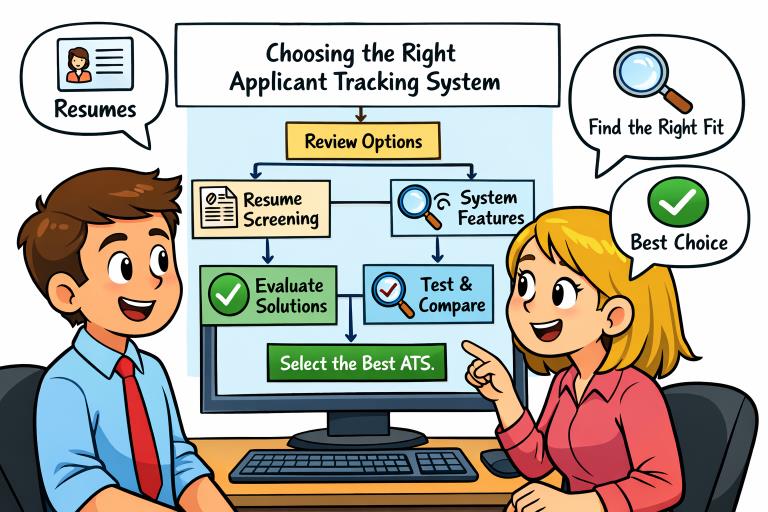
In today’s competitive hiring landscape, businesses need smart tools to attract and secure high-quality candidates. One of the foundational technologies for efficient recruitment is an Applicant Tracking System (ATS). Selecting the right ATS can transform your entire hiring process, boost team productivity, and help you secure top talent faster. As companies debate the merits of recruiting CRM vs ATS, understanding your hiring priorities will guide you toward the perfect software solution.
An ATS does more than manage applications. It enhances candidate experience, speeds up hiring, streamlines workflows, and ensures your recruitment process remains competitive. However, with the variety of systems available, from simple platforms for startups to complex suites for enterprises, it’s important to know what features and factors truly matter to your business.
Assess Your Recruitment Needs
Before evaluating potential systems, start with a clear understanding of your unique recruitment demands. What is your current and expected hiring volume? Are you recruiting for specialized roles or high-volume, entry-level positions? The complexity and scale of your hiring drive the type of ATS that will deliver the most value. For example, small businesses hiring infrequently may need only basic automation, while mid-sized and large companies may require robust candidate management, sourcing, and collaboration features.
Also consider the structure and size of your HR team. Smaller teams may prioritize simplicity and affordability, while larger teams might benefit from customizable workflows, advanced automation, and detailed permissions management. Aligning your true hiring requirements with an ATS’s functional offerings will significantly narrow your choices and help pinpoint solutions to your specific challenges.
Evaluate User-Friendliness
The usability of your ATS can determine team adoption rates and the platform’s overall effectiveness. Look for a system that offers a clean, intuitive interface so recruiters and managers can quickly post jobs, progress candidates, and collaborate with minimal training. Candidate-centric features such as one-click apply, mobile app options, and straightforward communication tools improve the applicant experience while simplifying daily tasks for your HR team.
To ensure broad adoption and swift onboarding, consider requesting a demo or free trial. Involving several team members in the evaluation process can uncover usability issues and reveal whether a particular solution genuinely aligns with your daily hiring workflows. For more tips on evaluating usability in HR technology, explore resources like SHRM’s guidelines on choosing HR software.
Consider Integration Capabilities
Efficient hiring is closely tied to an ATS’s ability to “play well” with your current HR and business systems. Integration reduces manual data entry and ensures seamless information flow across core platforms, including payroll, onboarding, background screening, and performance management software. Make sure your shortlisted ATS solutions can connect with your essential systems, as well as leading job boards and social networks, to maximize the visibility of your roles and speed up the hiring process.
If you rely heavily on digital collaboration tools or third-party assessments, investigate whether your candidates’ information can be easily transferred across platforms without the need for time-consuming manual work. A well-integrated ATS saves time, reduces errors, and helps create a unified experience for both recruiters and candidates. Harvard Business Review offers additional insights in its article, “How to Select the Best HR Software for Your Company.”
Analyze Reporting and Analytics Features
Recruiting strategies are only as strong as the data behind them. That is why your ATS must offer comprehensive and customizable reporting. Useful analytics include metrics like time-to-hire, source effectiveness, candidate drop-off rates, and diversity statistics. These insights empower you to refine processes, quickly identify bottlenecks, evaluate recruiters’ performance, and clearly demonstrate recruitment ROI to leadership.
Ideally, reports should be user-friendly and easy to generate. An advanced analytics dashboard allows your team to make data-driven decisions without tedious manual work. If metrics are especially critical to your hiring strategy, prioritize platforms that enable custom reports based on your specific needs.
Review Customer Support and Scalability
As you roll out a new ATS, quality customer support helps address issues quickly and keeps your business running smoothly. Review the types of support available, such as live chat, phone, email, onboarding assistance, and knowledge base resources. Quick response times and knowledgeable service teams are particularly valuable during peak hiring seasons or when implementing new features.
Additionally, assess the system’s scalability. As your company evolves, will the ATS adapt to higher volumes, more complex workflows, or new recruiting locations? Choosing a scalable solution avoids burdensome migrations later and ensures your investment remains relevant as your hiring needs change.
Understand Pricing and Total Cost of Ownership
ATS costs can vary widely depending on the vendor, your feature requirements, and the pricing structure, whether per user, per job posting, or per company size. Look beyond basic subscription fees and ask about additional costs for setup, integration, user licenses, feature upgrades, or advanced support services. An upfront understanding of all costs helps you avoid surprises and allows for more accurate budgeting.
Calculating the total cost of ownership, including hidden fees, ensures you select a solution that meets your business needs without straining your budget.
Conclusion
Selecting the right Applicant Tracking System requires careful consideration of your organization’s current and future recruiting needs. Prioritize features that match your workflow, seek systems with strong user experience, ensure robust integrations, and demand actionable analytics and support. By approaching your ATS search strategically, you lay the foundation for an efficient, candidate-friendly, and scalable hiring process for long-term success, and by making the right technology investment now, you set your business up to consistently attract the best talent for years to come.