Today, traditional rigid event spaces that were designed to accommodate one event at a time from start to finish are no longer a good fit. Businesses now require multiple activities to be effortlessly sequenced throughout the day, in a single, or across multiple event spaces. From workshops, trainings, and coaching, to seminars, keynotes, and networking, the more value that can be wrung from the facility, the better.
Why The Hub-And-Spoke Layout Works
The most common mistake in multi-functional event design is treating each zone like its own separate room. People plant themselves in one spot, bottlenecks form, and before long you’ve got a floor plan that feels more like a collection of disconnected spaces than a single cohesive event.
A hub-and-spoke layout solves this by placing a central networking lounge at the heart of everything, with breakout areas radiating out from it. The lounge isn’t dead space between sessions – it’s the natural throughway people pass through as they move around. And when people are moving, they’re bumping into each other. That’s where the good conversations happen.
Don’t underestimate your wayfinding signage either. When someone can instantly read a space and know where they’re headed, they stop stressing about navigation and start actually looking around – noticing who else is there, making eye contact, striking up a conversation. Getting lost is just wasted time. Making it easy to find your way is, quietly, one of the best things you can do for the social energy of an event.
Designing Social Zones That Actually Work
The old models just don’t work. Using a space as a blank canvas for attendees to fill creates dead spots and huddled masses; the speaker-then-mixer structure often forces you to choose between engagement or fun.
The first step in modern social-first design is accepting that you need at least three smaller gathering spaces in play at any given time. For the high-energy portion of corporate events, local partners like Epic Party Team – Phoenix, AZ bring the activation expertise to turn a standard corporate space into a genuine social environment where density feels energetic rather than overcrowded.
Next, it’s all about flow. Traditional planners talk about ‘traffic’ when they really mean ‘attendees’ – in reality, the majority of your gathering doesn’t have a heartbeat. They’re stuck in a two-dimensional model where ‘entering’ and ‘exiting’ are all they get, rather than a continuous flow.
Once you have the right number of spaces and the right movement through them, it’s about creating an environment where people are more likely to jump or less likely to get stuck. To break bad habits in this stage of development, get rid of chairs. Seriously, chairs are for dinners or speakers – all they do for mingling events is provide a place to hide.
Flex-Seating Replaces Fixed Rows
Seating like in a theater is like sending your attendees a message: “Sit down and be quiet.” That’s a problem when you’re trying to set the stage for an interactive keynote and then want them to get into working groups 40 minutes later.
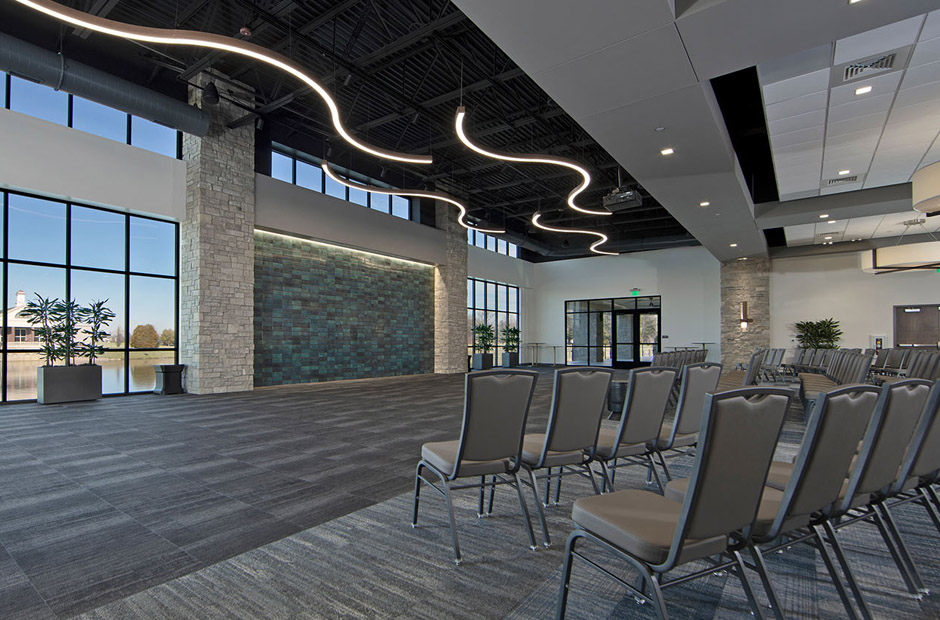
Modular furniture – lightweight tables, stackable chairs, movable whiteboards – allows a room to transform itself during a short break rather than requiring 20+ minutes between sessions. A well-equipped room can be flipped by a couple of hotel staff in under 10 minutes.
The second benefit is psychological. When your audience knows they can’t get up and move around, they don’t. When they know they have the flexibility to gather around the presenter or to reconfigure the room to work on a problem, they do.
Sensory Cues Do Real Signal Work
According to the American Express Global Events Trends report, 82 percent of event professionals now prioritize attendee engagement as their primary success metric. This has led the design focus to transition from aesthetics to functional interactivity. And there are two unsung heroes in the interactivity design toolbox: light and sound.
In meetings, lighter, brighter, blue-toned, higher Kelvin lighting helps keep attendees alert and engaged in those lethargic post-lunchtime slots. Meanwhile, warmer, dimmer, amber-tainted light lets them instinctively know when day is done and it’s social time in the bar.
Light also helps set the stage for interactions. Ensuring that every part of a meeting space is well lit (without glare from directly facing a light source) is a no-brainer.
Light is often the prime controller of our circadian rhythms, but sound plays a role too, particularly in focusing our attention. That’s where acoustic management comes in.
The Transition Is The Event
Seamless movements from one part of an event to another are critical in determining whether a multi-functional event space is truly successful or if it’s simply a sum of its parts. The room should transform purposefully from one event type to the next rather than devolve into controlled chaos.
This is accomplished by planning how lighting, furniture, and wayfinding will change from one type of event to another. Biophilic design, an approach that brings the outside in by incorporating natural elements such as plants, natural textures, and even natural daylight when possible, becomes a unifying visual theme that helps tie everything together.