Many new firearm owners concentrate on the gun: what caliber, what finish, what holster? They research ballistics, compare manufacturers, and agonize over accessories. Storage, if it crosses their mind at all, tends to be an afterthought – something to sort out after the purchase. It should be the other way around. A firearm without a storage plan isn’t just an oversight; it’s a liability.
Before you even get the gun, you must have a strategy, not simply a device. The weapon itself is only one piece of a much larger system of responsibility.
Start With A Vulnerability Assessment
Examine your house for weaknesses in your security posture. Determine which points of entry a burglar could exploit, where they would target first, and where your most valuable possessions are stored. How long would it take them to locate your gun?
Your answer to where you keep your gun should come from this self-inspection, not from a predetermined list of optimal locations. That list won’t include the kitchen or under the bathroom sink, but if those are the places that best meet your specific circumstances, that’s where the gun should be staged.
It’s also worth thinking beyond the break-in scenario. Consider who regularly enters your home – tradespeople, babysitters, houseguests, relatives – and how much unsupervised access they have to different areas. A staged firearm that’s accessible to you in an emergency should not be equally accessible to a contractor working in your home for the afternoon. Your vulnerability assessment isn’t a one-time exercise done with burglars in mind. It’s an ongoing audit of everyone and everything that moves through your space.
Build A Layered Defense System
Having just one barrier won’t stop a break-in. The most secure approach is to have multiple barriers: first, a locked room, and then a locked container within that room. Each additional barrier takes more time for a thief to breach, which is the essence of security.
Different types of storage serve different purposes, with trigger locks as the most basic form of security and vault rooms at the top. Which step on the hierarchy should you choose for firearm storage? The answer depends on your particular circumstances. For a single adult with no kids, the decision will be different from a household with teens, or one that frequently entertains visitors.
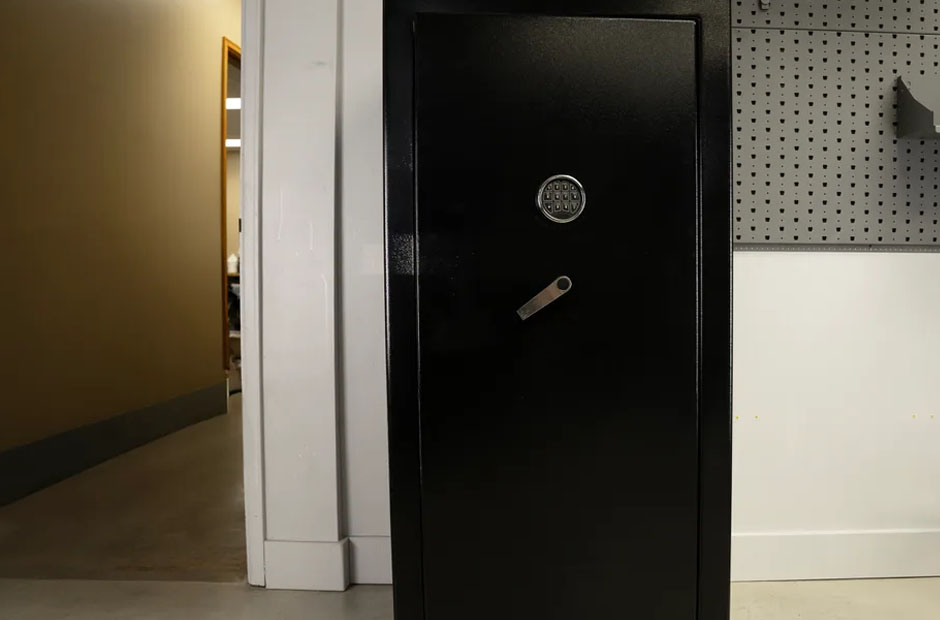
For the greatest level of protection, a fortified room and a Gun Safe Door create a secure perimeter that’s tough to breach using either hand tools or power tools. The thickness of the steel also makes a difference. Thinner steel is vulnerable to tools found at any hardware store. A safe with a UL-rated door is a game changer.
Account For Fire And Environmental Damage
Intruders are a greater concern in people’s minds. However, fires are often underestimated. The average household fire burns at 1,100°F. More than enough to compromise internal configurations, reduce polymer integrity, or cause ammo to ignite if it’s not properly sealed.
Fire-rated storage isn’t just about keeping thieves away from your guns, It’s also about keeping your guns from threatening your safety in a crisis. We recommend a fire rating of 1,200°F for 30 minutes, minimum. That will give the fire suppressant in your safe or cabinet time to work before any of the materials in your storage begin to self-ignite.
Humidity is low and slow. But corrosion builds quietly, especially in areas with large seasonal humidity changes. A dehumidifier rod or desiccant will cost you pennies per month to operate in your safe. It will extend the working life and reliability of your firearm by ten times that. This should not be an add-on feature you think about later. It should be a non-negotiable.
Develop A Household Protocol
The four rules of gun safety are your baseline every time you handle the firearm. Individual discipline is not enough. Your household needs a shared protocol.
That means having a direct conversation with everyone in the home about what happens in an emergency. Who moves to the safe room? Who retrieves the firearm, and under what conditions? What does “Code Red” mean in your house, and has anyone practiced it under stress?
The distinction between staging and storage matters here. A firearm staged for home defense is “at the ready” but still secured – a quick-access biometric unit keeps it right there for the authorized user without leaving it exposed. Long-term storage is different, and ammunition should be kept in a separate locked container when the firearm won’t be accessed for an extended period.
Treat This As An Ongoing System, Not A One-Time Setup
Review your safety plan whenever there is a change in your household dynamic – new residents, children becoming older, changes in your own situation. The NSSF’s Project ChildSafe program has good guidelines for resisting unwelcome access, and their resources are good to have up to date.
Also, perform regular maintenance on your storage systems. Fasteners shake loose. Electronic locks need fresh batteries. Desiccant packs eventually need to be “cooked off” or replaced. A safe storage plan that is solid today will not be if you never revisit it six months from now.
It’s common for new gun owners to treat the acquisition as the finale. It’s the beginning. The gun is now an element of a safe storage plan that needs continuous implementation – physical, mechanical, and administrative. The physical part has to be done correctly first, and then you build the routines and household culture around it. That’s the difference between just having a gun and properly preparing to own one.