Alvin and Sarah stood in their empty flat on the day they collected the keys, each holding a coffee, having a mild argument about where the shoes should go. He wanted them at the door. She wanted no shoes in sight. The argument was small, but it contained the whole question of the home they were about to build.
Couples like them often end up searching for bespoke interior design in Singapore after discovering that standard layouts do not quite fit the way they live. This guide explains what bespoke means in practice, what it asks of you, and which questions to bring to a first meeting.
What Bespoke Really Means
Bespoke design starts from your brief, not from a set menu of packages. The designer begins by understanding how you live, then works outwards to a layout, materials and custom carpentry made for the space.
That is different from a standard renovation, where finishes and layouts are often chosen from a fixed range. Neither approach is wrong, and the right one depends on your home, your budget and your patience.
Start With Your Daily Routine
Before meeting a designer, spend a week noticing. Where do you drop your keys when you come in? Where do wet umbrellas go? Who cooks, and when? How often do you host, and how many people?
Write these down, even in messy notes. These details are the raw material of a good design. Alvin and Sarah’s list was two pages long, and the shoe argument turned out to be only the first item.
Awkward Corners Are Opportunities
Every home has an awkward corner, such as a pillar in the wrong place, a low ceiling, or a bomb shelter door that interrupts a wall. A good designer treats these as design inputs and not as problems to hide.
Ask, when you meet a designer, how they would handle the most awkward part of your home. Their answer will show you how they think far better than a portfolio of finished rooms.
The Trade-offs Nobody Mentions
Bespoke work can be wonderful, and it also asks more of you. There are usually more decisions to make, and custom carpentry often takes longer to produce than standard pieces. Costs depend on the design and materials you choose, and they can be higher than a standard approach.
That is not a reason to avoid it. It is a reason to ask about it early. Ask how long each stage takes, who coordinates the carpentry, and what happens if you change your mind midway.
Questions for Any Designer
These are worth taking to a first meeting.
- How do you begin, and what do you ask me before drawing anything?
- How will you handle the awkward parts of my home?
- What does a typical timeline look like, stage by stage?
- Who manages the carpentry and the contractors on site?
- How are costs presented, and what could change them?
- Can I speak to someone whose home you designed?
Keep It Coherent
One benefit of bespoke work is that everything can come from one set of materials and ideas, so the home feels like a whole. A common mistake is to choose finishes first, and then try to fit the layout around them. It usually works better the other way round. Settle how the space works, and then choose how it looks.
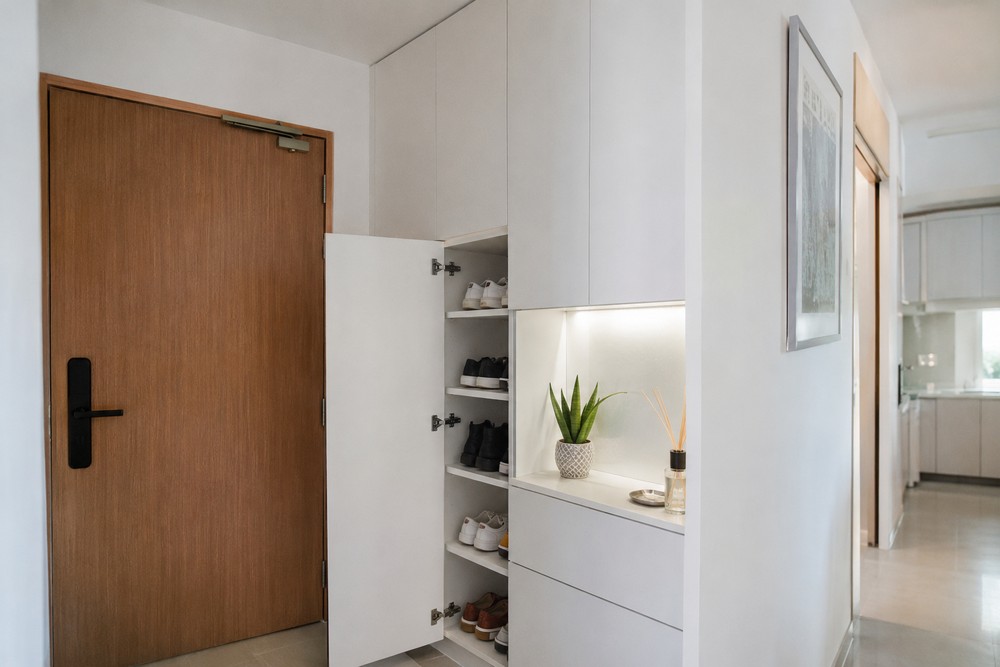
Alvin and Sarah eventually found their answer. The shoes live in a slim cabinet by the door, shut away behind a panel that matches the wall. He can reach them, and she cannot see them. It is a small solution, but it came from asking how they actually live, and that is where good design begins.