Identify Scratch Depth With a Quick Fingernail Test
Before any polish touches paint, take a moment to learn what you are fixing. The fingernail test is fast and revealing. Gently drag a clean fingernail across the mark. If the nail glides without catching, you are likely looking at a clearcoat scratch. These are surface blemishes that typically respond well to buffing and a quality scratch remover. If the nail catches just a little, the damage probably reaches the base coat and has removed color. If you see gray, white, or exposed metal under the color layer, the scratch has reached the primer or the bare substrate. That level of damage needs careful repair to prevent rust and to restore a uniform finish.
Clearcoat scratches are the most common and often come from car washes or light contact. Base coat scratches cut into the color layer and need touch-up paint. Primer or metal exposure is the most serious and carries a high risk of corrosion if neglected.
Tools and Materials You Will Need
Having the right products on hand makes the work smoother and safer. For light clearcoat scratches, prepare clean microfiber towels, a scratch-removal compound, a foam or microfiber polishing pad, and isopropyl alcohol to clean oils and residue.
For deeper scratches, plan on touch-up paint matched to your vehicle’s exact paint code, a compatible clearcoat, primer for any areas where bare material is exposed, and sandpaper in the 1500 to 3000 grit range. Masking tape helps protect edges and neighboring panels during sanding and painting.
Budget accordingly. DIY scratch-removal kits tend to cost 15 to 50 dollars. Touch-up paint kits usually range from 20 to 60 dollars. Materials for advanced repair efforts including primer, sandpaper, and clearcoat often total 50 to 150 dollars.
Fixing Light Clearcoat Scratches
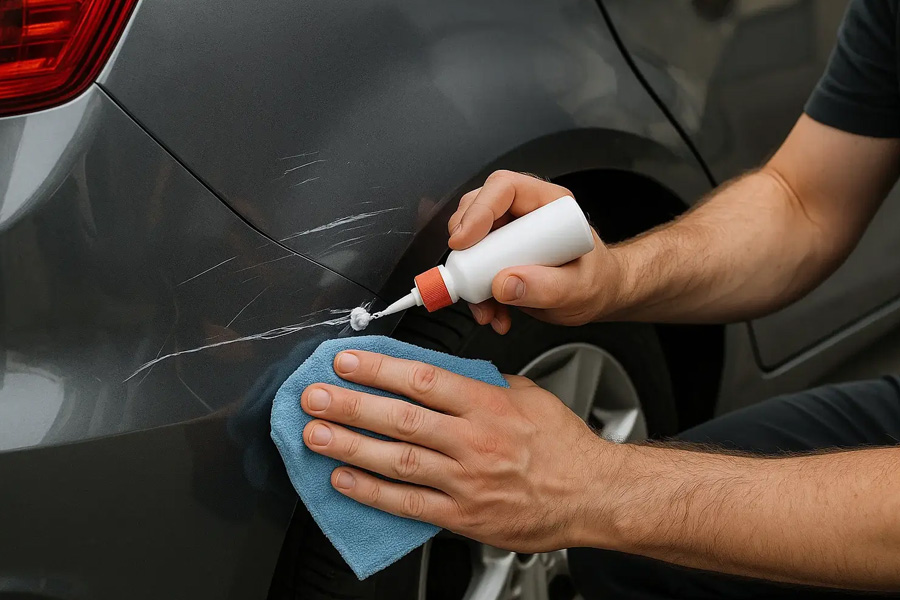
Start clean. Wash and dry the area thoroughly so you do not grind dirt into the finish. If there is wax or sealant on the surface, wipe it down with a bit of diluted isopropyl alcohol. This step ensures the compound contacts the clearcoat directly.
Apply a small dot of scratch-removal compound to a microfiber towel or a polishing pad. Work the product over the scratch using firm, circular motions. Keep the area small, roughly the size of a hand, and count your passes. Around 20 to 40 seconds is usually enough to see improvement. Wipe away residue and inspect under good light. If the scratch persists, repeat lightly rather than scrubbing aggressively. The goal is to level the clearcoat, not to thin it excessively.
Polish for clarity and shine. A mild finishing polish restores mirror-like shine. Shallow scratches will fade or disappear. Avoid overworking the scratch if it’s visible but faint. Impatience can cause haze, but a deliberate second try can assist.
Repairing Deeper Paint or Primer Scratches
Deeper damage calls for patience and layering. Begin by cleaning the panel well. Mask off the surrounding area so you do not accidentally sand or paint beyond the scratch. Use 1500 to 2000 grit wet sandpaper to gently feather the edges of the scratch. The aim is to smooth the transition between damaged and intact paint. Keep the paper wet, move in short, gentle strokes, and check frequently. Oversanding can create more work than it solves.
Seal the substrate with a thin priming coat if primer or metal is exposed. Let it dry completely. Touch-up paint should match your vehicle’s paint code. Shake or stir paint to manufacturer instructions. Use a fine brush or applicator to apply thin coats, letting each dry before adding more. Thin layers level well and reduce ridges.
Once color coverage looks even, seal the repair with clearcoat. Again, thin coats are best. Give the clearcoat enough time to cure. After the finish has fully hardened, use 2000 to 3000 grit wet sandpaper to lightly level any high spots if needed, then polish to blend the shine with the surrounding panel. Watch color match closely. Metallics and pearls are notoriously tricky. If the blend looks obvious from a few steps away, professional blending may be the wiser path.
When DIY Should Wait
Not all scratches can be fixed at home. Large or jagged marks can be difficult to repair and leave patches. A curving body line makes it difficult to level scratches without distorting the reflection, which highlights the repair. Collision damage and purposeful keying that gouges numerous layers require skilled repair.
Be mindful of modern vehicle technology. Many cars house sensors, cameras, and radar systems near bumpers, mirrors, and quarter panels. Aggressive sanding or repainting close to these systems can interfere with calibration. If the scratch sits near a sensor lens or trim where electronics are tucked behind, consult a professional before starting work.
Professional Repair Options
Paint correction with machine polishing is ideal for deeper clearcoat scars and widespread swirl marks. Skilled technicians use multi-stage compounds and pads that remove defects while preserving healthy clearcoat.
Professional touch-up and blending address localized color loss. Technicians can fade color and clearcoat into the surrounding area so the eye does not catch a transition line. This is particularly valuable on metallic paints or panels that play with light.
Full panel repainting is reserved for severe scratches or when multiple marks disrupt a single panel. A complete repaint ensures a durable finish and a consistent color match, especially when previous repairs have left uneven texture.
Cost Overview for Professional Scratch Repair
Costs vary by paint type, panel size, and the amount of prep required. Light scratch buffing tends to run 50 to 150 dollars for surface-level clearcoat damage. Spot repair and touch-up usually lands between 150 and 350 dollars, covering localized color or clearcoat issues. A full panel repaint often ranges from 300 to 1000 dollars and depends on whether the paint has metallic or pearl characteristics, how much sanding and masking is required, and the level of finish desired. Deep scratches or collision-related damage commonly cost 500 to 2500 dollars or more, as these repairs can involve filler, priming, sanding, precision color matching, and blending into adjacent panels.
Preventing Future Scratches
Good habits shield paint like armor. Proper washing techniques matter. Avoid automatic car washes with brushes since they can create micro-scratches over time. Use a gentle hand wash with a pH balanced soap, separate buckets for wash and rinse, and soft microfiber mitts and towels. Dry with plush microfiber to limit contact friction.
Consider paint protection film for high-impact zones such as bumpers, hood edges, and door cups. Ceramic coatings add a slick barrier that helps resist light marring and UV damage while making cleaning easier. Where you park matters too. Choose spots with breathing room, avoid tight spaces near shopping carts, and steer clear of overgrown hedges that can trace lines across clearcoat.
FAQ
How do I find my car’s paint code?
Most vehicles display the paint code on a label in the door jamb, under the hood, or in the trunk near the spare. The owner’s manual often lists the label location. Use the code rather than guessing by eye to ensure a precise match.
Can I use toothpaste to remove scratches?
Toothpaste is a very mild abrasive that can reduce haze, but it is inconsistent and can leave residue. A proper automotive scratch remover is formulated for clearcoat hardness, offers predictable cut, and finishes cleaner. Use toothpaste only as a last resort on very light marks.
How long should touch-up paint cure before applying clearcoat?
Let touch-up color dry fully according to the product instructions. As a general rule, give it several hours at minimum and up to 24 hours for best leveling. Temperature and humidity influence cure times. Rushing clearcoat over soft color can trap solvents and cause texture issues.
Is wet sanding safe for beginners?
Wet sanding can be safe if you go slow, use fine grit, keep the surface lubricated, and stop frequently to inspect. The risk is removing too much clearcoat or creating a flat spot that catches light. Practice on a hidden area or defer to a professional if you are unsure.
Will DIY scratch repair void my warranty?
Most paint warranties cover factory defects, not wear and tear or damage. DIY correction does not typically void a warranty, but poor repairs that harm the finish may complicate future claims. Keep work limited to the damaged spot and follow product directions.
Do ceramic coatings stop all scratches?
Ceramic coatings resist light marring and make cleaning safer, but they do not render paint scratch proof. They add hardness and slickness, which helps reduce micro-scratches. Heavy contact or abrasive debris can still mark the finish. Proper washing remains essential.
What if the scratch is on a plastic bumper?
Plastic and painted bumper covers can be repaired similarly to metal panels. The difference is the substrate flexes more. Use compatible primer and flexible clearcoat where required. Color matching and blending are especially important on large curved bumper surfaces.