
Understanding Digital Marketing and Conversion Optimization
Many businesses invest significantly in digital marketing to attract visitors. But what happens once those visitors arrive? We’ve seen that getting traffic is only half the battle. The real challenge is turning those visitors into customers.
This is where the powerful combination of digital marketing and conversion optimization comes into play. It’s not just about increasing online visibility; it’s about making that visibility profitable. A fundamental part of this is ensuring you have a strong, visible online foundation, such as SEO-friendly websites.
In this extensive guide, we will explore how digital marketing and conversion optimization work together to achieve sustainable growth. We will uncover strategies to maximize your online visibility and turn more visitors into loyal customers. We will also look at how to identify friction points, apply effective CRO tactics, and measure the true impact on your revenue and customer experience.
At its core, digital marketing is about reaching your target audience online, engaging them, and driving them towards a desired action. This encompasses a vast array of tactics, from search engine optimization (SEO) and paid advertising to social media marketing and email campaigns. The ultimate goal is to generate traffic and leads.
However, simply attracting visitors isn’t enough. This is where Conversion Rate Optimization (CRO) becomes critical. CRO is the systematic process of increasing the percentage of website visitors who complete a desired goal, such as filling out a form, making a purchase, or signing up for a service. This desired goal is known as a “conversion.”
Consider your sales funnel – the journey a potential customer takes from initial awareness to becoming a paying customer. Every step in this funnel presents an opportunity for a visitor to drop off. CRO meticulously analyzes each stage to identify and remove obstacles, making the path to conversion smoother and more intuitive. By focusing on user intent and understanding customer behavior, we can significantly reduce customer acquisition costs and amplify the revenue impact of our existing traffic.
The power of effective conversion rate optimization cannot be overstated. Doubling your conversion rate from, say, 2% to 4% has the exact same revenue impact as doubling your website traffic, but at a fraction of the cost. This fundamental principle underscores why CRO is not merely an add-on but a foundational pillar of successful digital marketing. It transforms raw traffic into tangible business outcomes, ensuring that every marketing dollar spent works harder.
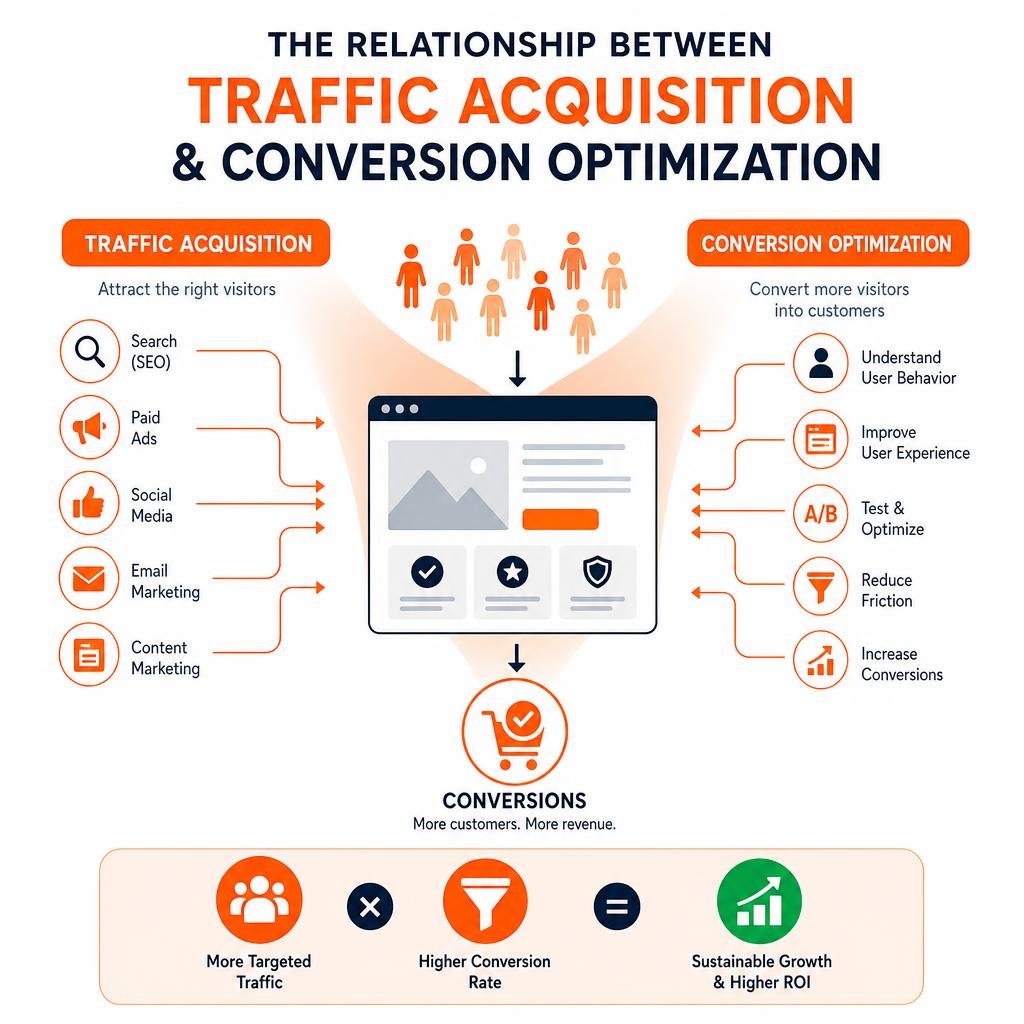
Traffic vs. Conversion: Determining Your Growth Priorities
A common dilemma businesses face is whether to prioritize increasing traffic or improving their conversion rate. While both are vital for growth, understanding their interplay and cost implications is key to making strategic decisions. Many businesses spend significant amounts on paid traffic, driving thousands of monthly visitors to their sites. Yet, if their conversion funnel is leaky, much of that investment is wasted.
Driving Traffic vs. Improving Funnel Performance
Traffic acquisition, whether through paid ad spend, SEO, or content marketing, is essential for top-of-funnel reach. Strategies like optimizing for keywords, running targeted ad campaigns, and building backlinks all aim to bring more potential customers to your digital doorstep. However, blindly pursuing more traffic without an optimized funnel is akin to pouring water into a sieve. The cost per click (CPC) and overall acquisition costs can quickly escalate, leading to diminishing returns if visitors aren’t converting efficiently.
For instance, a B2B company spending $15,000/month on ads but only generating three demo requests needs to critically evaluate their funnel. While increasing ad spend might bring more visitors, optimizing their demo request pages with benefit-driven copy, fewer form fields, and trust signals could triple their demo requests within 30 days without increasing their ad budget. This highlights the profound impact of funnel optimization.
For businesses looking to sustainably expand their reach and improve their search engine rankings, investing in elite SEO services can be a game-changer. SEO not only drives organic traffic but also builds long-term authority and visibility, complementing CRO efforts by bringing in high-intent visitors who are more likely to convert.
Utilizing Digital Marketing and Conversion Optimization for Sustainable ROI
The smart approach involves a balanced strategy. First, establish baseline metrics for your current conversion rates. If your conversion rates are low (e.g., 1-2%), focusing on CRO will likely yield a higher and faster return on investment than simply increasing traffic volume. Why? Because improving your conversion rate leverages your existing traffic, turning a greater percentage of those visitors into customers without additional acquisition costs.
We’ve observed that small friction points in a sales funnel can each leak 5-15% of potential customers. When these leaks multiply across a multi-step process, it can result in losing 60-80% of the revenue that traffic should generate. Addressing these leaks dramatically improves revenue per visitor, making your digital marketing spend far more efficient.
Once your funnel is optimized and converting efficiently, then scaling traffic acquisition efforts becomes a much more profitable endeavor. This synergistic approach ensures that every increase in traffic translates into a substantial increase in revenue, driving scalable growth and a strong return on investment.
Identifying and Eliminating Friction Points Across Sales Funnels
The journey to higher conversions begins with understanding where and why potential customers are abandoning your funnel. This requires a combination of quantitative data analysis and qualitative user research.
Quantitative Analytics and Qualitative User Research
Quantitative data provides the “what” – where users are dropping off. Tools that offer clickstream data, user heatmaps, and funnel analytics can pinpoint specific pages or steps where engagement wanes. For example, a heatmap might reveal that users are not interacting with a key call-to-action (CTA) button, or funnel analytics might show a significant drop-off rate on a particular form page.
However, quantitative data often doesn’t explain the “why.” This is where qualitative user research comes in. Techniques like Voice of Customer (VOC) data, customer feedback surveys (including embedded cancellation surveys), and user interviews provide direct insights into user motivations, pain points, and expectations. Combining these two approaches allows us to validate hypotheses and truly understand the friction points. For instance, analytics might show a high cart abandonment rate, but a cancellation survey could reveal that unexpected shipping costs or mandatory account creation are the primary culprits.
Modern Techniques in Digital Marketing and Conversion Optimization
Once friction points are identified, modern CRO employs a range of techniques to optimize the user experience and streamline conversion paths. These often involve “surgical fixes” rather than complete overhauls. Most significant conversion gains come from targeted adjustments, such as:
- Headline Optimization:Crafting benefit-driven headlines that immediately communicate value.
- Visual Hierarchy:Ensuring the most important elements (CTAs, key information) stand out and guide the user’s eye.
- Form Field Reduction:Eliminating non-essential fields in forms to reduce perceived effort and abandonment.
- Social Proof Placement:Strategically placing testimonials, reviews, and trust badges to build confidence.
- Streamlined Checkout Flows:Simplifying the number of steps, offering guest checkout, and providing clear progress indicators.
For any business, having a robust and user-friendly website is the foundation for these optimizations. A site that is difficult to navigate, slow to load, or not mobile-responsive will inherently create friction. This is why investing in SEO-friendly websites is not just about search rankings, but also about providing a solid, high-converting platform for your visitors. These sites are designed with both search engines and user experience in mind, making them ideal candidates for advanced CRO techniques.
High-Impact Optimization Strategies for SaaS, E-Commerce, and B2B
Conversion optimization isn’t a one-size-fits-all approach. The most effective strategies are tailored to the specific business model, customer journey, and unique challenges of SaaS, e-commerce, and B2B companies. Each industry has distinct funnel alignment and opportunities for significant conversion uplift.
SaaS Trial and Onboarding Flow Optimization
For SaaS companies, the primary conversion often revolves around trial sign-ups, demo requests, or free plan registrations. The goal is to get users to experience the product’s value as quickly and smoothly as possible.
- Form Simplification:A SaaS platform with 10,000 monthly visitors and a 1.8% trial signup rate saw rates climb to 4-6% within 60 days by simplifying a 9-field form. Reducing the number of required fields and using smart defaults can significantly reduce drop-off.
- Social Proof:Placing testimonials, customer logos, or user statistics prominently above the fold on landing pages builds trust and encourages sign-ups.
- Benefit-Driven Copy:Clearly articulate the immediate value proposition of the trial or free plan. What problem does it solve for the user?
- Onboarding Flow:Once signed up, the initial onboarding experience is crucial. A smooth, guided process that quickly showcases key features can drastically improve activation rates and reduce churn.
E-Commerce Cart Abandonment Reduction
E-commerce businesses frequently battle high cart abandonment rates, often exceeding 70%. Optimizing the checkout process is paramount.
- Guest Checkout:Mandatory account creation is a major friction point. Offering a guest checkout option can improve cart completion rates by 25-40%.
- Transparency on Costs:Surprise shipping costs or hidden fees are deal-breakers. Displaying all costs upfront, including taxes and shipping, builds trust.
- Progress Bars:Visually indicating progress through the checkout steps (e.g., “Shipping > Payment > Review”) reassures users and reduces perceived effort.
- Payment Localization:For global e-commerce, supporting localized payment methods, currencies, and languages is critical. This adapts to buyers’ preferences for a frictionless purchasing experience.
- Exit-Intent Offers:Strategically deployed exit-intent pop-ups can offer incentives (e.g., a small discount or free shipping) to users about to leave their cart.
B2B Lead Generation and Demo Request Streamlining
B2B conversion often focuses on generating qualified leads, typically through demo requests, content downloads, or contact forms.
- Reduced Form Fields:Similar to SaaS, B2B forms are often too long. A B2B company spending $15,000 monthly on ads tripled demo requests within 30 days by streamlining a 12-field form down to just 4 fields. Focus only on essential information needed for qualification.
- Benefit-Driven Copy:On demo request pages, clearly articulate what the prospect will gain from the demo, rather than just what the product does.
- Trust Signals:Include client logos, industry awards, security badges, and case study snippets near conversion points to build credibility.
- Scheduling Tools:Integrating calendar-based scheduling tools directly on the demo request page simplifies the process for prospects and increases booking rates.
- Clear CTAs:Use action-oriented and benefit-focused calls to action (e.g., “Schedule Your Free Demo,” “Get a Custom Proposal”) instead of generic “Submit.”
Scaling Optimization with AI and Advanced Testing Methodologies
As digital marketing environments become more complex and data-rich, leveraging artificial intelligence (AI) and advanced testing methodologies is no longer a luxury but a necessity for scaling conversion optimization efforts beyond manual testing.

A/B Testing Requirements and Statistical Significance
A/B testing (and multivariate testing) is the backbone of data-driven CRO. It involves comparing two or more versions of a webpage or element to see which performs better against a specific conversion goal. However, for results to be reliable, statistical significance is crucial.
- Visitor Thresholds:A general rule of thumb is that A/B testing for conversion optimization requires roughly 1,000 visitors per month per page being tested to achieve statistical significance within a reasonable timeframe (e.g., 2-4 weeks). Below this threshold, optimization often relies more on qualitative analysis and industry best practices.
- Test Duration:Running tests for too short a period can lead to false positives. It’s important to run tests long enough to capture variations in user behavior across different days of the week or seasonal trends.
- Baseline Conversion:Understanding your current conversion rate (baseline) is essential for setting realistic goals and measuring the impact of your tests.
While data collection tools like heatmaps show where users click or leave, they don’t explain why or implement fixes. The true power lies in designing experiments based on insights, executing them, and then analyzing the statistically significant results to make informed decisions.
AI-Driven Personalization and Intent-Based Automation
AI and machine learning are revolutionizing CRO by enabling hyper-personalization and automated optimization at scale.
- AI Agents:Imagine an “AI agent” that not only analyzes user behavior but also diagnoses issues, formulates optimization strategies, and even helps implement testing infrastructure. These systems go beyond simple analytics, providing a diagnostic layer that generates specific solutions.
- Predictive Analytics:AI can analyze vast datasets to predict user behavior, identifying segments of visitors most likely to convert or churn. This allows for proactive optimization and personalized experiences.
- Intent-Based Triggers:Traditional, disruptive pop-ups can harm user experience. AI-driven systems leverage behavioral data to deploy intent-based triggers, such as exit-intent pop-ups (when a user is about to leave the page), scroll-depth triggers, or time-on-page triggers. These are far less intrusive and more effective because they respond to specific user actions.
- Dynamic Personalization:AI can dynamically alter website content, CTAs, and offers based on individual user profiles, past behavior, and real-time context. This ensures that each visitor sees the most relevant version of your site, maximizing their likelihood of conversion.
- Automated Workflow Optimization:AI can automate the testing process, from generating hypothesis variations to launching and monitoring tests, and even recommending winning variations based on performance data. This allows businesses to run more experiments faster, accelerating the pace of conversion improvements.
Essential Metrics to Measure CRO Success and Common Pitfalls
Measuring the true impact of conversion optimization is crucial for demonstrating ROI and guiding future strategies. However, it’s equally important to avoid common mistakes that can derail efforts.
Key Performance Indicators for Revenue Impact
While conversion rate is the most obvious metric, a holistic view requires tracking several KPIs to understand the full revenue and customer experience impact:
- Conversion Rate:The percentage of visitors completing a desired action. This is the primary metric for CRO.
- Revenue Per Visitor (RPV):This metric directly links optimization efforts to financial outcomes. A higher RPV indicates that your traffic is becoming more valuable.
- Average Order Value (AOV):For e-commerce, CRO can influence AOV through upsells, cross-sells, and pricing optimization.
- Customer Lifetime Value (CLTV):By improving the initial conversion and subsequent user experience, CRO can contribute to higher customer retention and CLTV.
- Drop-off Rates:Tracking drop-off rates at each stage of the funnel helps pinpoint specific areas needing improvement.
- Form Completion Rates:For lead generation, improving the percentage of forms completed is a direct measure of success.
- Bounce Rate & Exit Rate:While not directly conversion metrics, improvements here can indicate a better user experience that supports conversion.
Strategy Focus SaaS E-commerce B2B Primary Goal Trial/Demo Sign-ups, Onboarding Sales, Cart Completion, AOV Lead Generation, Demo Requests Key Metrics Trial-to-Paid Rate, Activation Rate, CAC Conversion Rate, AOV, Cart Abandonment Lead-to-Opportunity, SQL Conversion Rate Optimization Tactics Form simplification, Social Proof, Guided Onboarding Guest Checkout, Transparent Pricing, Payment Localization Reduced Form Fields, Trust Signals, Scheduling Tools Typical Impact 2-3x Signup Rate, Reduced Onboarding Drop-off 25-40% Cart Abandonment Reduction, Increased AOV 2-3x Demo Requests, Higher Lead Quality Avoiding Common Conversion Rate Optimization Blunders
Even with the best intentions, businesses often make mistakes that hinder their CRO efforts:
- Focusing on Full Redesigns Instead of Surgical Fixes:Most conversion gains come from targeted, surgical fixes (e.g., rewriting a headline, removing three form fields, adding a testimonial). Full redesigns are costly, time-consuming, and often fail to deliver significant conversion lifts because they introduce too many variables at once. Prioritize incremental, testable changes.
- Stopping Tests Prematurely:Ending an A/B test before it reaches statistical significance can lead to incorrect conclusions and implementing changes that actually harm conversions. Patience and adherence to statistical rigor are key.
- Implementing Disruptive Pop-ups Aggressively:While pop-ups can be effective, overly aggressive or poorly timed ones (e.g., immediately upon page load) destroy user experience. Replace them with intent-based triggers that provide value at the right moment.
- Making Unvalidated Assumptions:Relying on “gut feelings” or opinions rather than data to make optimization decisions is a recipe for failure. Every change should be a hypothesis to be tested.
- Ignoring Mobile Experience:With a significant portion of traffic coming from mobile devices, neglecting mobile optimization is a critical oversight that creates immense friction.
- Not Tracking the Right Metrics:Focusing solely on top-line conversion rate without understanding revenue impact or user journey drop-offs provides an incomplete picture.
Frequently Asked Questions About Digital Marketing and Conversion Optimization
Navigating digital marketing and CRO often brings up common questions, especially for businesses new to these concepts.
What is a good conversion rate baseline across different industries?
Conversion rates vary significantly by industry, business model, traffic source, and even the specific goal. There isn’t a single “good” conversion rate. For instance:
- E-commerce:Typical conversion rates might range from 1% to 4%, with higher-value products often having lower rates.
- SaaS:Trial signup rates can range from 2% to 10%, while demo request rates might be lower, around 1% to 5%.
- B2B Lead Generation:Form submission rates can vary widely, from 5% to 20% depending on the offer (e.g., a simple newsletter signup vs. a detailed whitepaper download).
Instead of chasing an industry average, focus on improving your own baseline conversion rate. A 20% improvement on your current rate is far more valuable than knowing another company has a 5% higher rate.
How long does it take to see statistical significance in A/B testing?
The time it takes to achieve statistical significance depends primarily on three factors:
- Traffic Volume:Pages with higher traffic will reach significance faster. As mentioned, roughly 1,000 visitors per month per page being tested is a good benchmark for reliable results within a few weeks.
- Current Conversion Rate:Pages with very low baseline conversion rates will require more traffic and time to detect a statistically significant improvement.
- Expected Lift:If you anticipate a large improvement from your test, it will reach significance faster than a test expecting a small, incremental gain.
Generally, tests should run for at least one full business cycle (e.g., 2-4 weeks) to account for weekly variations in user behavior. It’s crucial not to stop a test simply because one variation appears to be winning early on; this can lead to misleading conclusions.
Should small businesses focus on redesigns or targeted optimizations?
For most small businesses, especially those with limited resources, focusing on targeted, surgical optimizations is almost always the more effective and cost-efficient approach.
- Cost-Effectiveness:Full website redesigns are expensive and time-consuming. Targeted optimizations, like improving a single landing page or streamlining a form, offer a much higher ROI for the investment.
- Reduced Risk:A full redesign introduces many changes simultaneously, making it difficult to pinpoint what specifically led to an improvement or decline. Incremental testing allows for precise measurement of each change’s impact.
- Faster Results:Surgical fixes can yield statistically significant results and conversion uplifts within 30-60 days. This rapid feedback loop allows for continuous improvement.
- Data-Driven Decisions:Targeted optimizations are inherently data-driven. You identify a specific problem area, hypothesize a solution, test it, and measure the impact. This iterative process builds a strong foundation for sustainable growth.
While a complete redesign might eventually be necessary for outdated platforms, it should ideally be undertaken after significant conversion insights have been gathered through ongoing optimization efforts.
Conclusion
In the ever-evolving landscape of online business, the synergy between digital marketing and conversion optimization is not merely beneficial—it’s indispensable. Attracting visitors is the first step, but converting them into customers is where true revenue growth is realized. We’ve seen that doubling your conversion rate can have the same revenue impact as doubling your traffic, but at a fraction of the cost, making CRO an incredibly powerful lever for profitability.
By systematically identifying and eliminating friction points within your sales funnels, leveraging industry-specific strategies for SaaS, e-commerce, and B2B, and embracing advanced methodologies like AI-driven personalization and rigorous A/B testing, businesses can unlock significant untapped potential. The goal is not just to attract more eyes, but to make every single visit count.
An integrated approach that continuously tests, analyzes, and refines the user journey leads to sustainable growth, higher customer lifetime value, and robust, high-converting funnels. In August 2026, the businesses that prioritize both visibility and conversion are the ones truly maximizing their online potential.