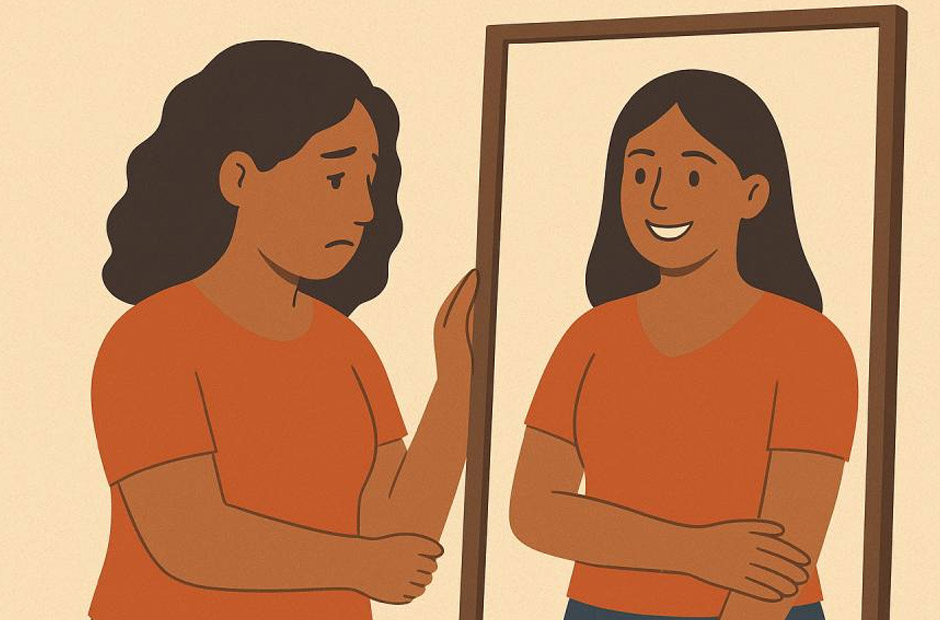
Believing that your worth is inherent, no matter your size or shape or height, is a wonderful mindset to chase. But actually reaching it is a whole other matter. Self-esteem isn’t simply the result of a more positive self-narrative, because that narrative is in part constructed by your body. It’s hard to truly believe that weight doesn’t matter when the world is built to ensure it does. And it’s even harder when the weight was the key, if unintentionally, to years of misery.
The Cognitive Load Of Hiding
When someone is preoccupied with a physical feature, it’s not occasional mental distress. It’s constant, low-grade mental discomfort. Editing smiles out of photos, mentally calculating the best angle to minimize a perceived flaw, avoiding laughs that expose teeth. This is cognitive load: your unconscious mind has a CPU running 24/7, and it’s quietly consuming some of your processing power.
This has a real impact. It dilutes your focus during dates and interviews. It fuels social anxiety, as mundane encounters become stage performances. And with repetition, it reinforces all your worst fears and insecurities. The focus isn’t on what you’re revealing to the world. It’s on what you’re hiding.
Addressing the root cause doesn’t just fix an aesthetic problem. The entire preoccupation vanishes, and with it, the cognitive load. Suddenly people are funnier, more energetic, offer to take pictures, their eyes track you effortlessly in conversation. It’s not the physical flaw that disappeared; it’s all that mental noise.
Why Smiling Changes The Brain – Not Just The Room
There is a known science behind it: the facial feedback hypothesis. The physical act of smiling, even if done consciously, releases neuropeptides that lower stress and improves mood. The brain receives a signal from the muscles and responds accordingly at a neurochemical level. Dopamine is released in response to the feeling of a smile, whereas combined muscle resistance and lack of smiling tend to result in a more negative experience. These reinforcement signals are powerful in building new habits; overlaying new smiles over frowns can slowly shift our taste equilibrium towards the more positive.
The feedback loop is crucial. A person who used to block their smile now smiles more often. That smile generates more positive social signals. These signals consolidate a positive feeling of being appreciated and watched. The person smiles more. The loop compounds. This is not a trifle: this is how the transformation theory builds on real life.
From External Change To Internal Shift
The most important thing to understand about physical transformation and building confidence is that the external change is the trigger, not the destination. A corrected alignment or improved appearance doesn’t hand someone a new identity. What it does is remove the friction that was making a better self-image harder to maintain.
This is where CBT principles become relevant. Changing a behavior – or in this case, a physical condition – interrupts an entrenched thought pattern. The brain stops running the old script because the evidence for it has changed. That’s not vanity. It’s a form of cognitive reframing that happens to have a physical entry point.
For anyone considering this kind of change, finding the right professional makes a significant difference in both outcome and experience. Consulting an Orthodontist in Chessington is a practical starting point for those who want treatment that’s clinically sound and tailored to their specific situation – not a one-size approach.
75% of adults who underwent orthodontic treatment reported significant improvements in their career and social lives, attributing the change primarily to increased self-confidence (_American Journal of Orthodontics and Dentofacial Orthopedics_). That figure reflects something consistent: the internal shift tends to be larger than people expect before they start.
Confidence and Professional Presence
The impact isn’t just on personal exchange, either. In business situations, a silent discussion could be sending a variety of messages, encompassing how broadly an individual is smiling, their stance, and whether they’re maintaining direct eye contact or not. These visual cues are processed in milliseconds, frequently before any actual words are exchanged. And, because of this halo effect, an individual who appears at ease physically is often believed competent, warm, _and_ authoritative in mere seconds.
Those who are more satisfied with their appearance are statistically more likely to apply for jobs above their experience level, negotiate for themselves, and simply exist professionally without making themselves scarce. Self-efficacy – the confidence that you can achieve goals in specific environments – increases when you don’t have to waste mental resources on hiding. That’s not just a health metric. It’s a career metric.
The Discipline Inside The Process
Another way to look at it is this: the process of transformation is a hell of a teacher, regardless of the material. Take something as commonplace as orthodontia – it’s a course of treatment that usually spans months. You have to show up, which means you’ll also be learning about commitment and delayed gratification. You have to build incremental habits over time, and monitor yourself. Not only that, you’ll have to do this while dealing with ongoing discomfort and uncertainty as to whether your investments of time and pain will ever pay off in transformed features.
You will eventually find that skill and those habits transfer. It’s not quite that mechanical, of course. Hopefully the improvements to your mental landscape come along with those to your physical one. But even if they don’t, the new habits have a funny way of starting to teach you about the latticework of mental discipline in return.