Common Causes, Injuries, and Determining Liability
Bus travel, while often a safe and efficient mode of transport, is not without its risks. When accidents occur, the consequences can be severe due to the sheer size and weight of these vehicles. Understanding the common causes, the types of injuries sustained, and who can be held responsible is crucial for anyone considering a claim. Bus operators, whether private companies or public transit authorities, are generally considered “common carriers,” meaning they owe a higher duty of care to their passengers than typical drivers. This elevated duty implies a greater responsibility to ensure passenger safety, making driver negligence, vehicle maintenance, and operational practices key areas of scrutiny in any liability assessment.
Primary Factors Behind Commercial Bus Collisions
Bus accidents rarely stem from a single cause; often, a combination of factors contributes to these incidents. However, certain issues consistently emerge as primary culprits in commercial bus collisions:
- Driver Fatigue: Long shifts and demanding schedules can lead to bus drivers experiencing fatigue, impairing their judgment, reaction time, and attentiveness. This can be particularly dangerous on long-haul routes or during late-night operations.
- Distracted Driving: Despite strict regulations, bus drivers can become distracted by cell phones, onboard equipment, or even passengers. A moment of inattention can have catastrophic results, especially given the weight and momentum of a bus.
- Mechanical Failure: Buses are complex machines requiring rigorous maintenance. Brake failure, tire blowouts, steering issues, or engine problems can lead to accidents. These failures often point to negligence on the part of the bus company or maintenance contractors.
- Speed Violations: Driving too fast for conditions, or exceeding posted speed limits, significantly reduces a driver’s ability to react to hazards and increases the severity of any impact.
- Blind Spots: Buses have extensive blind spots, making maneuvers like lane changes or turns inherently risky. Drivers must exercise extreme caution, and failure to do so can result in collisions with smaller vehicles, pedestrians, or cyclists.
- Hazardous Road Conditions: While drivers cannot control the weather or road defects, they are expected to adjust their driving to account for rain, ice, snow, or poorly maintained roads. Failure to do so can contribute to an accident.
Physical and Psychological Trauma Sustained by Passengers
The impact forces in a bus accident can be immense, leading to a wide range of severe injuries for passengers and others involved. Unlike cars, many buses lack seatbelts, increasing the risk of passengers being thrown around the cabin. Common injuries include:
- Whiplash and Other Soft Tissue Injuries: The sudden jolt of a collision can cause severe neck and back strains, even from an emergency stop. While often considered minor, whiplash can lead to chronic pain and long-term disability.
- Spinal Injuries: From herniated discs to severe spinal cord damage, these injuries can result in partial or complete paralysis, requiring extensive medical care and rehabilitation.
- Traumatic Brain Injury (TBI): Head impacts against hard surfaces or being jostled violently can cause concussions or more severe TBIs, leading to cognitive, emotional, and physical impairments.
- Fractures: Broken bones, ranging from limbs to ribs, are common due to the force of impact, often requiring surgery and prolonged recovery.
- Internal Injuries: Organs can be damaged by sudden deceleration or direct impact, leading to internal bleeding or other life-threatening conditions.
- Emotional Distress and PTSD: Beyond physical harm, bus accidents can leave deep psychological scars. Victims may experience anxiety, depression, fear of public transport, or Post-Traumatic Stress Disorder (PTSD), requiring therapy and ongoing mental health support.
Identifying Responsible Parties in a Personal Injury Bus Accident Claim
Determining liability in a bus accident can be complex, as multiple parties might share responsibility. Our goal is to identify every entity that contributed to the accident to ensure you receive full and fair compensation. Potential liable parties include:
- Bus Driver: If the driver’s negligence (e.g., distracted driving, speeding, fatigue) caused the accident, they are directly liable.
- Bus Company/Transit Agency: Employers are often held vicariously liable for the actions of their employees under the doctrine of respondeat superior. This means the company operating the bus (whether a private carrier or a public transit agency) can be held responsible for the driver’s negligence, inadequate training, poor maintenance, or unsafe operational policies.
- Third-Party Motorists: If another vehicle caused or contributed to the bus accident, that driver and their insurance company could be held liable.
- Bus Manufacturer: In rare cases, a defect in the bus’s design or manufacturing could be the cause, making the manufacturer responsible.
- Maintenance Contractors: If a third-party company was responsible for bus maintenance and their negligence led to a mechanical failure, they could be held accountable.
- Government Entities: If the accident was caused by poorly maintained roads, faulty traffic signals, or other infrastructure issues, the responsible government agency might be liable.
Understanding these potential avenues of liability is critical for building a strong case.
Legal Framework and Filing a Personal Injury Bus Accident Claim
Navigating the legal landscape after a bus accident can be daunting. A personal injury claim, often referred to as a tort claim, seeks to hold the at-fault party financially responsible for the damages you’ve incurred. Engaging legal representation is highly advisable, as experienced attorneys can guide you through settlement negotiations or, if necessary, litigation. In cases involving minors or individuals lacking mental capacity, a “litigation friend” (guardian ad litem) may be appointed to act on their behalf. For comprehensive guidance on pursuing such claims, exploring resources like a dedicated page on a Personal injury bus accident claim can provide valuable insights into the process.
Private Bus Companies vs. Public Transit Entities
A significant distinction in bus accident claims lies in whether the bus is operated by a private company or a government entity. This difference profoundly impacts the claims process, primarily due to doctrines like sovereign immunity and specific notice requirements.
- Sovereign Immunity: Government entities (like municipal transit authorities) often benefit from sovereign immunity, which protects them from lawsuits unless they waive this immunity or specific laws allow for such claims. This protection is not absolute but often imposes stricter rules on claimants.
- Notice Requirements: Claims against government entities typically have much shorter and more stringent notice periods. For instance, while a general personal injury claim might have a two-year statute of limitations in many states, a claim against a government entity could require a formal “notice of claim” within as little as 30 to 180 days from the accident date. Failure to meet these deadlines almost invariably bars your right to pursue compensation.
- Statute of Limitations: Even after the notice of claim, the overall statute of limitations for filing a lawsuit against a government entity can also be shorter than for private companies. For example, in Georgia, the general statute of limitations for personal injury is two years, but for claims against a government entity, it’s reduced to 12 months.
Understanding these distinctions is paramount. Missing a deadline, even by a day, can jeopardize your entire claim.
Feature Private Bus Company Claim Public Transit Entity Claim Liability Basis General negligence principles Negligence, but often limited by sovereign immunity Notice Period No specific pre-suit notice beyond standard legal process Strict, short notice of claim requirements (e.g., 30-180 days) Statute of Limitations Typically 2-3 years (varies by state) Often shorter, e.g., 12 months in some jurisdictions Damages Caps Generally no caps (unless punitive damages) Often subject to statutory caps on damages Process Complexity Standard personal injury litigation More complex due to specific governmental procedural rules
Essential Evidence to Prove Your Personal Injury Bus Accident Claim
Building a strong bus accident claim hinges on compelling evidence. The more thoroughly you document the incident and its aftermath, the stronger your position will be. Key pieces of evidence include:
- CCTV Footage: Many buses are equipped with internal and external cameras. This footage can be invaluable in showing the cause of the accident, driver behavior, and passenger movements.
- Black Box Data: Modern buses often have “black boxes” or Event Data Recorders (EDRs) that record speed, braking, steering, and other operational data, providing objective evidence of the bus’s actions leading up to the crash.
- Police Reports: Official accident reports contain crucial details gathered by law enforcement, including witness statements, diagrams of the scene, and initial determinations of fault.
- Driver Logs: These records document a driver’s hours of service, which can be critical in proving driver fatigue.
- Medical Records: Comprehensive medical documentation of your injuries, treatments, prognoses, and associated costs is fundamental to proving the extent of your damages.
- Witness Statements: Eyewitness accounts from other passengers, drivers, or bystanders can corroborate your version of events.
- Scene Photographs: Photos or videos taken immediately after the accident can capture vehicle positions, road conditions, visible injuries, and property damage.
- Bus Maintenance Records: These records can reveal if the bus was properly maintained, or if there were known mechanical issues that contributed to the accident.
Collecting this evidence promptly is vital, as some forms, like CCTV footage, may be overwritten quickly.
Settlement Valuation and the Compensation Claims Process
When pursuing a bus accident claim, understanding how compensation is calculated and what the claims process entails is essential. The goal is to recover damages that cover all your losses, both tangible and intangible. These typically fall into two categories: economic damages and non-economic damages. Economic damages cover quantifiable financial losses such as medical expenses, lost wages, and property damage. Non-economic damages address subjective losses like pain and suffering, emotional distress, and loss of enjoyment of life.
Key Factors Influencing Settlement Payouts
The value of a bus accident settlement can vary significantly, ranging from thousands to over a million dollars, depending on the specifics of the case. Nationally, bus accident settlements typically range from $5,000 to $300,000, but can exceed $1 million for catastrophic injuries or wrongful death. In California, for instance, injured bus passengers might see settlements between $12,000 and $30,000, while drivers hit by a bus could receive $100,000 to $500,000 or more. Several key factors influence these payouts:
- Injury Severity: This is often the most significant factor. Catastrophic injuries (e.g., severe spinal cord damage, traumatic brain injury, permanent disability) that require extensive medical treatment, long-term care, and result in permanent impairment will command much higher settlements than minor injuries like whiplash.
- Medical Expenses: The total cost of past and future medical care, including hospital stays, surgeries, rehabilitation, medications, and therapy, directly impacts economic damages.
- Lost Wages and Earning Capacity: Compensation covers income lost due to time off work, as well as future lost earning capacity if your injuries prevent you from returning to your previous job or working at all.
- Pain and Suffering: This non-economic damage accounts for the physical pain, emotional distress, mental anguish, and loss of enjoyment of life caused by the accident. It’s often calculated using a multiplier method based on economic damages.
- Comparative Fault: If you are found partially at fault for the accident, your compensation may be reduced proportionally based on your percentage of fault, depending on your state’s comparative negligence laws.
- Insurance Policy Limits: The maximum amount of compensation available is often limited by the at-fault party’s insurance policy limits. Buses, especially commercial ones, typically carry higher policy limits than private vehicles, but caps can still exist.
- Ongoing Care and Future Needs: If your injuries require long-term medical care, assistive devices, home modifications, or vocational retraining, these future costs will be factored into the settlement.
- Impact on Daily Life: How the injuries affect your ability to perform daily tasks, hobbies, and maintain relationships also contributes to the non-economic damages.
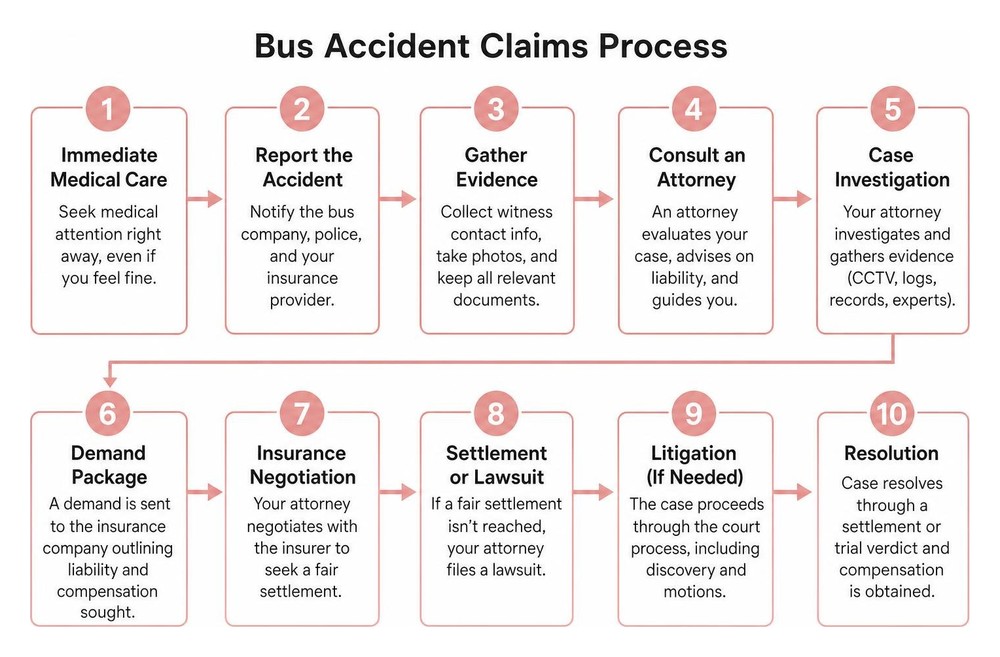
Step-by-Step Timeline of Bus Accident Resolution
While every case is unique, the claims process generally follows a predictable timeline. Bus accident lawsuits in the US are often resolved within 3 to 6 months if settled outside of court, but can take significantly longer if the case proceeds to trial.
- Immediate Medical Care: Your health is paramount. Seek medical attention immediately after the accident, even if you feel fine. This creates crucial medical records and addresses any latent injuries.
- Report the Accident: Notify the bus company, police, and your insurance provider as soon as possible.
- Gather Evidence: Collect contact information for witnesses, take photos, and keep all relevant documents (medical bills, police reports, correspondence).
- Consult an Attorney: An experienced personal injury attorney can evaluate your case, advise on liability, and guide you through the complexities.
- Case Investigation: Your attorney will conduct a thorough investigation, gathering evidence such as CCTV footage, black box data, driver logs, and expert testimonies.
- Demand Letter: Once your medical treatment is complete or a clear prognosis is established, your attorney will send a demand letter to the at-fault party’s insurance company, outlining your damages and requesting a specific settlement amount.
- Insurance Negotiations: This phase involves back-and-forth discussions with the insurance company. Many cases settle here.
- Filing a Lawsuit: If negotiations fail to yield a fair settlement, your attorney may file a lawsuit. This initiates the formal litigation process.
- Discovery: Both sides exchange information, including documents, interrogatories (written questions), and depositions (oral testimonies under oath).
- Mediation/Arbitration: Before trial, parties often attempt alternative dispute resolution methods to reach a settlement.
- Trial Proceedings: If no settlement is reached, the case goes to trial, where a judge or jury will hear evidence and determine liability and damages.
- Appeal: Either party may appeal the court’s decision.
This process can be lengthy, particularly if injuries are severe or liability is contested. Patience and persistent legal advocacy are key.
Frequently Asked Questions About Bus Accident Claims
Navigating a bus accident claim can raise many questions, especially concerning deadlines, potential complications, and compensation for less visible injuries. We aim to address some of the most common concerns.
How long do I have to file a claim after a bus crash?
The time limit for filing a personal injury claim, known as the statute of limitations, is critically important and varies by jurisdiction and the nature of the at-fault party. Generally, for personal injury claims in the United States, you have between one and six years, with two or three years being common in many states from the date of the accident.
However, as discussed, if a government entity owns or operates the bus, the deadlines can be significantly shorter. You might need to file a formal “notice of claim” within a few months (e.g., 30, 60, or 180 days) of the accident, followed by a shorter statute of limitations for filing a lawsuit (e.g., 12 months in Georgia).
There are also exceptions:
- Minors: For individuals under 18, the statute of limitations often doesn’t begin until they reach legal adulthood.
- Discovery Rule: In some cases, if an injury isn’t immediately apparent, the clock may start ticking from the date the injury was “discovered” or reasonably should have been discovered.
It is always in your best interest to consult with an attorney as soon as possible after an accident to ensure all statutory deadlines and notice requirements are met.
What happens if the driver or bus operator is uninsured or flees?
While commercial buses are typically required to carry substantial insurance coverage, scenarios involving uninsured drivers or hit-and-run incidents can complicate matters, especially if another vehicle caused the bus accident.
- Uninsured Motorist (UM) Coverage: If the at-fault driver of another vehicle is uninsured, your own auto insurance policy (if you have one) might include UM coverage that could compensate you. If you were a passenger on the bus, the bus company’s insurance policy may also have UM provisions that could apply.
- Phantom Vehicle/Hit-and-Run: If another vehicle caused the accident and fled the scene, leaving no identifiable information, it’s considered a “phantom vehicle.” Similar to uninsured motorist claims, your UM coverage or the bus company’s policy might cover your damages. Police reports and witness statements are crucial in these situations to prove the existence of the phantom vehicle.
- Corporate Liability: Even if a specific driver is uninsured or cannot be identified, the bus company or transit agency itself often carries significant liability insurance. Their corporate liability can still be pursued, holding them responsible for their driver’s actions or for failing to prevent the accident.
These situations underscore the importance of thorough investigation and experienced legal counsel to explore all potential avenues for compensation.
How are damages calculated for psychological trauma?
Psychological trauma, such as anxiety, depression, or PTSD, is a very real and often debilitating consequence of bus accidents. While not as outwardly visible as a broken bone, these injuries can significantly impact a victim’s quality of life and are compensable as part of “general damages” (non-economic damages).
- Psychiatric Evaluation: A key step in claiming psychological trauma is obtaining a diagnosis and treatment from mental health professionals (e.g., psychologists, psychiatrists). Their evaluations and testimony provide objective evidence of your condition.
- Impact on Daily Life: We document how the trauma affects your daily activities, work, relationships, and overall well-being. This can include inability to sleep, fear of driving or public transport, social withdrawal, or loss of enjoyment of hobbies.
- Multiplier Method: Often, psychological damages are calculated using a multiplier method, where the total economic damages (medical bills, lost wages) are multiplied by a factor (typically 1.5 to 5, depending on severity) to arrive at a figure for pain and suffering, which includes emotional distress.
- Per Diem Method: In some cases, a “per diem” (per day) amount is assigned for each day you experienced pain and suffering, from the accident date until maximum medical improvement.
It’s crucial to seek treatment for psychological injuries just as you would for physical ones. This not only aids in your recovery but also strengthens your claim for compensation.
Conclusion
Navigating the aftermath of a bus accident requires a clear understanding of your rights and the legal avenues available for recovery. From identifying the common causes and diverse injuries to understanding the intricacies of liability and settlement valuation, the process can be complex. We’ve outlined the critical steps, from immediate actions to the detailed claims process, emphasizing the distinct challenges presented by private versus public carriers.
Securing fair compensation for your injuries, medical expenses, lost wages, and emotional distress is about protecting your future. Timely filing, meticulous evidence gathering, and expert legal advocacy are indispensable. Do not hesitate to seek professional guidance to ensure your rights are protected and to embark on the path to recovery with confidence.