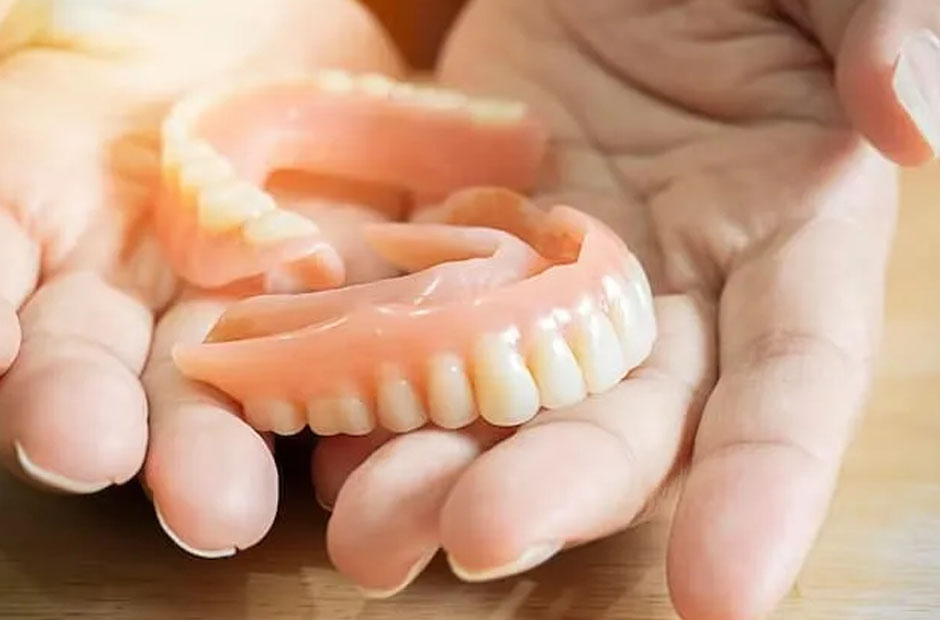
Traditional dentures may look okay, especially if you’ve seen some of the really old ones that yellow and warp, but disappointment gradually sets in as the years go by and the denture, designed to have a socket like fit, gets looser and looser. As it does so, it starts to move and rub and even the best quality ones can start to make your mouth sore. Sore enough that it can sometimes be fairly impossible to eat properly without wincing in pain.
The denture downward spiral
When a natural tooth is lost, the jawbone that used to support that tooth begins to atrophy, or shrink. This natural process occurs because the presence of natural teeth, and their roots embedded into the bone, supported the bone structure. When the roots are no longer there, the bone in that area is resorbed by the body to be used elsewhere. As a result, the jawbone begins to shrink. This is why denture wearers find that their dentures become loose over time and that they need to be replaced because they no longer fit properly.
Alveolar bone resorption is a common condition suffered by millions of people worldwide. Natural teeth provide the natural signals the body needs to tell it that there is still a reason to support the jawbone, due to chewing forces. When teeth are lost, the jawbone is no longer stimulated in this way and begins to atrophy.
The rate of bone loss varies from person to person, but studies suggest that the most significant changes happen within the first year after extraction. During this period, the ridge of bone where the tooth once sat can lose a substantial portion of its width and height. Over several years, this progressive deterioration can alter facial structure, causing the lower face to appear shorter and the chin to rotate forward. It can also make future dental treatments, such as implant placement, more complex, as there may not be enough healthy bone remaining to anchor a replacement tooth securely without additional grafting procedures.
How implants solve the structural problem
Full mouth dental implants for teeth are a titanium post that is implanted right in your jawbone. It functions essentially in the same way as your natural tooth’s root. When you are biting and chewing, the force is transmitted through the post right into the bone, giving it the necessary mechanical stimulation to continue being dense and strong. The specific biological function that allows this to function is osseointegration and this mechanisms allows the bone tissue to grow into the titanium and create a bond with it.
This creates a support point within your jawbone and the bone is not acting as a table-top for the denture. Over the years or decades, the bone loss significantly reduces and you can notice it in people that wore dentures for decades as their face structure changed – the cheeks sank and the lower face become a lot shorter than it was previously.
Many people think that if they lost teeth and wore dentures for many years, can’t get implants. It would take some initial bone grafting so the volume can be rebuilt, but in general, it will not disqualify you as a candidate.
Fixed bridges versus overdentures: choosing the right approach
There are different full-arch implant options, depending on the stability and budget you have in mind. The removable over denture option clips in and out and offers a mid-point solution cost and stability-wise. The fixed implant-supported bridge stays in the mouth, and is the most stable, but also the most expensive option. Opting for dental implants in this fixed format gives the prosthesis the structural support it needs to restore full biting force – something no removable option can fully replicate.
“Teeth in a day” – what’s real and what takes time
Marketing strategies often promote all-on-4 and all-on-6 scenarios as being fully-completed in a single day, so long as enough existing bone is healthy. But the before-and-after X-ray images provided by most clinics show just one patient; a unique individual who deserves a treatment uniquely suited to them. A careful consultation and after proper examination and diagnosis, none of these scenarios should be necessary if you wonder if they apply to you, because the true “scenario” that applies to you is the one developed in the treatment plan.
Replacing a body part, not managing a problem
The difference between dentures and implants is not just in how they feel, but in how they work. Dentures are like a Band-Aid. An implant is like a cast.
Dentures alleviate some of the problems caused by missing teeth. But their main disadvantage is that they do absolutely nothing to stop the jaw bone loss these problems set in motion. Implants do.