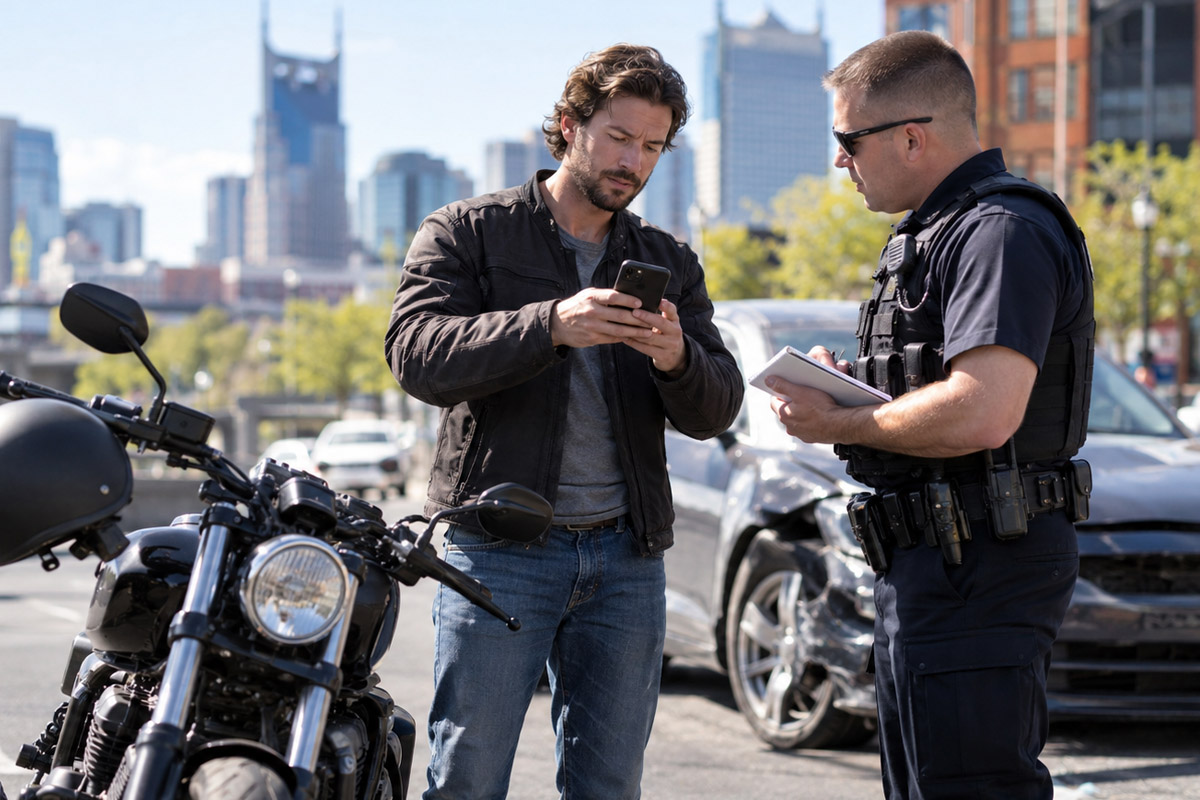
A motorcycle crash doesn’t end when the engine cuts off. It starts a paper trail, an insurance fight, and a clock you might not even know is running. The riders who come out of that mess with a fair outcome are almost never the ones with the loudest story. They’re the ones who handled the first 72 hours carefully. Here’s how to do the same, whether you’re riding a cruiser down Nolensville Pike or commuting over the Cumberland on a Tuesday morning.
The Roadside Ten Minutes Decide the Next Ten Months
Your first job isn’t proving anything to anyone. It’s getting off the asphalt and behind an ambulance door if you need one. Everything else, the photos, the witness numbers, the insurance call, can wait. It has to.
Once you’re stable, the next priority is getting a police report on file. In Tennessee you can request a crash report through the Department of Safety and Homeland Security, and that document becomes the backbone of nearly every claim. If officers never show up, or the responding officer waves you off with a “just exchange info,” ask for a report anyway. Riders who skip this step often spend weeks chasing a version of events that someone else got to write first.
Here’s the part most people fumble: what you say at the scene. Drivers, witnesses, and even a well-meaning bystander will ask whose fault it was. You don’t have the full picture yet, and neither do they. “I’m not sure what happened” is a complete sentence. Say it, then stop talking until you’ve called someone who can help you sort it out.
Document Like Your Claim Depends on It, Because It Does
Tennessee riders deal with a specific problem that car drivers don’t face. Left-turn collisions and lane-change sideswipes make up a huge share of motorcycle crashes, and those scenarios leave almost no physical evidence behind. No crumpled bumper. No shattered headlight. Just your word against theirs, plus whatever else you collected.
So collect aggressively:
- Photograph your bike from every angle, including the damage, the position in the lane, and the road surface itself, gravel, oil sheen, potholes, whatever’s there.
- Get the other driver’s insurance card and plate, not just a phone number. People go quiet fast.
- Snap photos of any visible injury the same day. Bruises fade, and fading bruises are worth money you’ll never see if you didn’t document them.
- Write down what you remember before it blurs. Memory drifts in the first week, and a written timeline from day one carries real weight later.
- Save the helmet and the jacket. Don’t throw away damaged gear. That scuffed helmet is evidence, not trash.
I’d take a twenty minute phone photo session over a perfect written statement every single time. Judges and adjusters respond to images in a way they never respond to adjectives.
What the Data Says About Why This Keeps Happening
Motorcycle crashes aren’t random. The patterns repeat across the country, and Tennessee sits squarely inside them. Highway safety research points to a consistent cluster of causes: a passenger vehicle turning left in front of a rider, a driver changing lanes without checking a blind spot, and intersection conflicts that happen because a car simply didn’t register that a motorcycle was there.
According to the Insurance Institute for Highway Safety, motorcyclists are vastly overrepresented in fatal crashes relative to passenger vehicle occupants, and a large share of those crashes involve another vehicle rather than a solo rider error. That’s not a scare tactic. It’s the reason why “the driver just didn’t see me” is the single most common sentence in motorcycle crash reports.
Front crash avoidance systems have gotten better at spotting cars. They remain uneven at spotting motorcycles, which means the technology that protects a sedan driver doesn’t automatically protect you. Ride like you’re invisible and you’ll be right more often than you’re wrong.
The Insurance Call Is Where Claims Quietly Die
Within a day or two, an adjuster will call. They’ll sound reasonable. They’ll ask how you’re feeling. They will also record everything you say, and that recording will be used to shrink your claim.
Three habits will protect you:
Never give a recorded statement to the other driver’s insurer. You aren’t required to, and nothing good comes from it. You can be polite and still decline.
Don’t accept the first settlement offer. Early offers land before your injuries have fully declared themselves. A soft tissue injury from Tuesday can look like a months-long problem by the following month, and once you sign a release, that door closes permanently.
Don’t post about the crash. A photo of you hiking six weeks after the collision, posted publicly, has ended more claims than any cross-examination I’ve seen described. Adjusters look. Assume they’re looking.
Tennessee follows a modified comparative fault rule, which means your recovery can be reduced by your share of the blame, and if you’re found more than half at fault, you recover nothing in most cases. That’s the rule adjusters lean on when they suggest you “might have been speeding a little.” They’re not making conversation. They’re building a percentage.
Why Local Knowledge Actually Matters Here
Motorcycle law is still personal injury law, and it’s still handled county by county. Nashville crashes land in Davidson County courts, with local filing procedures, local judges, and local defense firms that show up in the same rooms week after week. A statewide general practice attorney can absolutely help you. But if your case is contested, someone who knows the courthouse, the opposing counsel, and how claims move through the system has a practical edge that’s hard to fake.
That’s also true of the riding itself. A crash on I-440 during rush hour looks nothing like a crash on a back road in Williamson County, and the insurance arguments follow the setting. This is where motorcycle accident representation in Middle Tennessee stops being a category and starts being a specific strategy: which venue you’re in, what evidence that venue tends to reward, and how the other side is likely to frame you.
The other thing worth knowing is the deadline. Tennessee sets a one-year window for most personal injury claims under state law, and it runs from the date of the crash, not the date you felt better. Missing it usually means losing the claim outright. Waiting to “see how things settle down” is the most expensive decision a rider can make, and it doesn’t feel expensive until it’s too late.
A Practical Checklist for the First Week
If you take nothing else from this, take the sequence. It’s short and it matters.
- Get medical attention, even if you feel fine. Adrenaline covers a lot.
- Confirm a crash report exists and request your copy.
- Photograph everything: bike, gear, injuries, road, and location.
- Write your own timeline while it’s fresh.
- Decline recorded statements and hold off on signing anything.
- Ignore the first offer until an attorney has seen the full picture.
- Check the calendar. The one-year clock is already running.
Insurance requirements for Tennessee riders are set by the state, and you can review the specifics through Tennessee’s state government if you’re unsure what coverage you’re actually carrying. Plenty of riders discover after a crash that their policy excludes exactly the situation they just lived through.
Don’t Let a Bad Week Turn Into a Closed Case
The worst outcomes I’ve watched riders accept didn’t come from weak crashes. They came from good crashes handled fast and tired, by people who wanted the whole thing to be over. The system is patient. You should be too.
Protect the evidence, watch what you say and post, and get a real read on what your claim is worth before anyone gets you to sign. If something about the offer feels off, that instinct is usually worth acting on. Talk to someone who handles these cases in your county, and do it while the clock still has room on it.