Key Takeaways
- Home care and nursing facilities serve different needs, and the right choice depends on safety, health needs, daily support, and personal preferences.
- Many people can remain at home with help for meals, personal care, mobility, transportation, and companionship.
- Nursing facilities may be appropriate when a person needs around-the-clock skilled care or supervision that cannot be safely provided at home.
- Families should consider the care recipient’s wishes, caregiver capacity, home safety, finances, and changing medical needs before deciding.
- A care plan should be reviewed after a fall, hospitalization, major health change, or increase in caregiver stress.
Choosing between care at home and a nursing facility can be one of the most personal decisions a Collegeville family faces. The goal is not simply to find the most convenient option. It is to create a setting in which a loved one can receive appropriate support, preserve dignity, and remain as safe and comfortable as possible.
For many families, home-based assistance offers a flexible starting point. Personal health care can help families consider support that fits a loved one’s routines, including assistance with daily activities, companionship, and help that may be adjusted as needs change.
Understanding the Difference Between Home Care and Nursing Facilities
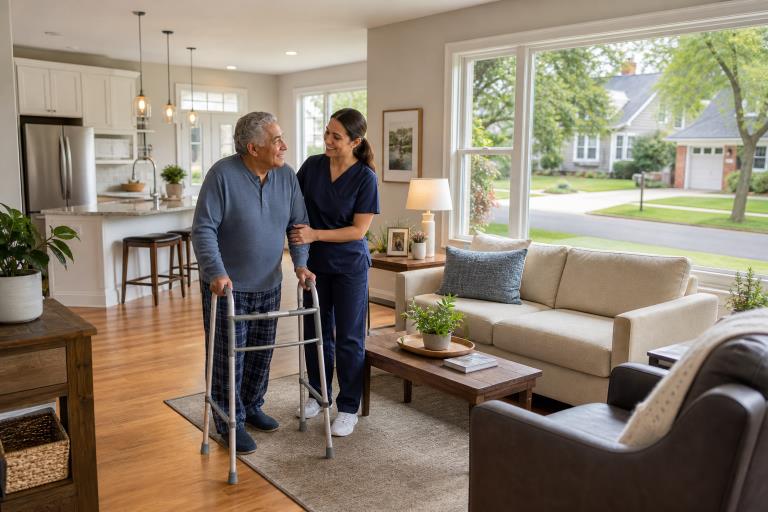
Home care brings support into the person’s residence. Depending on the care plan, this may include help with bathing, dressing, meal preparation, light housekeeping, errands, reminders, mobility, transportation, and social connection. Some people need only a few hours of weekly help, while others need regular daily assistance.
Nursing facilities provide care in a residential setting outside the home. They are generally designed for people who need substantial ongoing support, skilled nursing services, rehabilitation, or close supervision. A nursing facility may be a short-term option after a hospitalization or a longer-term solution when care needs become too complex for the home environment.
When Home Care May Be the Better Fit
Home care can work well when a person wants to remain in familiar surroundings and can do so safely with the right support. Familiar rooms, neighbors, pets, routines, and community connections can make a meaningful difference in daily comfort and emotional well-being.
Situations That Often Support Care at Home
- The person needs help with selected tasks but can still participate in daily decisions.
- Family members can provide some assistance, coordinate care, or serve as backup contacts.
- The home can be adapted to reduce hazards by adding grab bars, improving lighting, or clearing walking paths.
- Care needs are predictable and can be covered through scheduled visits or family support.
- The person benefits from staying close to local friends, faith communities, and familiar activities.
A careful home safety review is important before deciding that aging in place is practical. The steps involved in planning to age in place include anticipating changing needs, reviewing the home environment, and identifying services that may help a person remain independent.
When a Nursing Facility May Be Necessary
There are times when the level of care needed exceeds what family members or in-home caregivers can reasonably provide. Choosing a nursing facility does not mean a family has failed. In some circumstances, it may be the safest and most responsible choice.
Signs a Higher Level of Care May Be Needed
- Frequent falls, wandering, or unsafe attempts to walk without help.
- Complex medical needs that require skilled care or regular clinical monitoring.
- Repeated medication errors, missed meals, dehydration, or difficulty managing personal hygiene.
- Significant memory loss, confusion, or behaviors that create safety risks.
- Caregiver exhaustion, illness, or insufficient available support to cover essential needs.
- A home layout that cannot be made safe or accessible despite reasonable changes.
Families should also recognize that the decision is not always permanent. Some people enter a nursing facility for rehabilitation after surgery, illness, or injury and later return home with a revised care plan and added support.
Comparing Daily Life and Independence
Home care usually offers more control over daily routines. A person may wake up at their preferred time, eat familiar meals, choose activities, and remain closely involved in household life. This flexibility can be especially valuable for someone who is capable of making choices but needs practical assistance to carry them out safely.
Nursing facilities offer structure, available staff, organized activities, and access to care in one location. However, residents may need to follow established meal schedules, medication routines, visiting rules, and facility policies. Families should ask how a prospective facility supports individual preferences, privacy, personal belongings, and meaningful social engagement.
Safety Should Guide the Conversation
Safety should be assessed honestly, without assuming that staying home is always best or that a facility is automatically safer. A person living at home may be safe with mobility assistance, medication reminders, meal support, and regular check-ins. Another person may need continuous supervision that cannot reliably be arranged in the home.
Falls deserve particular attention because they can quickly change a person’s mobility and confidence. The risk of serious injury from falls among older adults can be reduced by addressing hazards, reviewing medications that may contribute to dizziness, checking vision, and discussing appropriate strength and balance activities with a healthcare professional.
Questions Collegeville Families Should Ask
- What help does our loved one need each day, and which tasks can they still manage safely?
- Are there medical needs that require skilled nursing or frequent clinical oversight?
- Can the home be adapted for safer bathing, walking, stairs, and nighttime movement?
- Who can provide care, and what happens if the primary caregiver is unavailable?
- How will we communicate about appointments, medications, changes in health, and emergencies?
- What costs are involved, including care hours, transportation, home modifications, or facility services?
- What does the person receiving care want, and how can those preferences be respected?
Create a Plan Before a Crisis
Families have more choices when they plan before a fall, hospital stay, or caregiver emergency forces an immediate decision. Start by writing down daily needs, safety concerns, medical information, key contacts, and the people responsible for specific tasks. Include backup plans for evenings, weekends, illness, and unexpected changes.
A good plan also leaves room for adjustment. Review it after any change in mobility, memory, appetite, medications, diagnoses, or caregiver availability. Whether a loved one remains at home or moves to a nursing facility, the best choice is the one that balances safety, quality of life, reliable support, and the person’s individual needs.