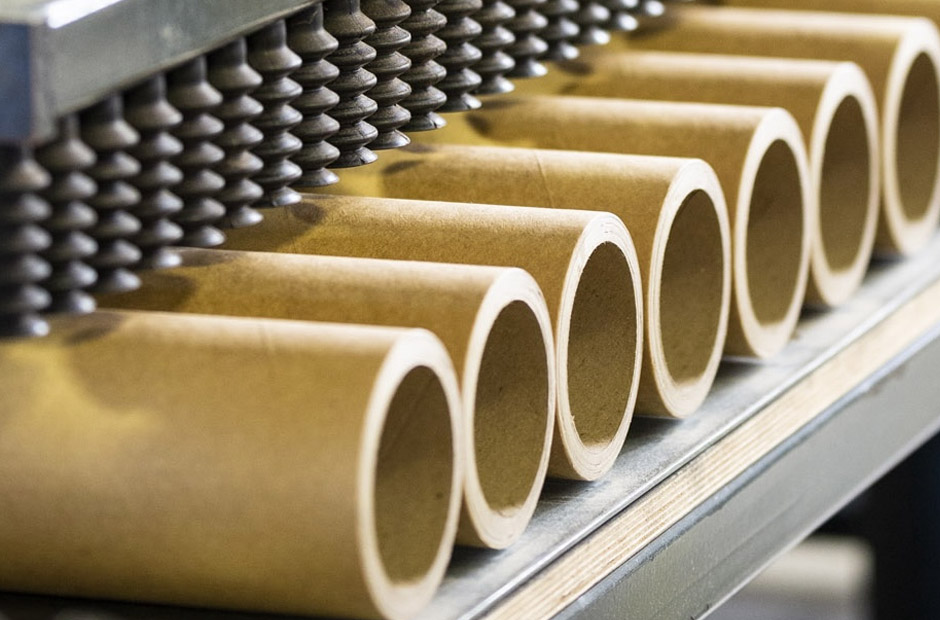
Paper core manufacturing involves a series of steps that affect the quality and durability of the final product. Understanding the manufacturing process helps businesses select the appropriate paper cores for different products and applications. Here are a few steps paper core manufacturers take that facilitate the production of paper cores:
Raw Material Selection
Paper and recycled fibers are key raw materials for paper core production. Controlling fiber weight and quality during recycling helps maintain the integrity of raw materials for future use. This assists in regulating the production and resource consumption so they meet market demand. Paper tube manufacturers can source raw materials with the appropriate fiber length, orientation, and density to deliver high-strength tubes. In some food‑contact applications, manufacturers use virgin or certified food‑grade paper because it’s easier to verify compliance with safety and hygiene standards. Adjusting fiber composition and processing methods improves core performance for specific applications.
Advanced Core Winding Techniques
Spiral winding involves wrapping a paper strip around a rotating mandrel, bonding it to form a continuous tube. This design offers round cores with no seams. Convolute winding forms straight seams by layering and gluing paper sheets; both methods create durable cores with controlled bond strength. These techniques are used by core manufacturers to produce film cores, tape label cores, and yarn carriers that meet specific industrial requirements.
Cutting machines are used to create straight, narrow slits that form cones that support yarn and provide guidance and protection during production. This protects yarn from drag and creases during winding and unwinding. Paper cores require precise winding strength and dimensional consistency for material handling and finishing applications. High-density cores allow tight winding of thicker materials while remaining lightweight, making them easy to handle during converting operations.
Refined Finishing and Quality Control
Automated cutting machines provide the same tube lengths, regardless of the order size. Paper cores are inspected throughout the winding and finishing process. Core diameter and wall thickness are measured, confirming that product accumulation capacities remain consistent across batches.
Marking equipment inspects surface features and verifies proper yarn capture on cores before they are sent to textile mills. These procedures safeguard the integrity of every core, including paper product cores. Paper core manufacturers benefit from high-performance equipment for producing high-quality cores for their customers.
Load testing measures if spools, reels, and construction tubes meet the end-use load requirements. Dimensional checks confirm if packaging cores hold stability tolerances in bag-in-box or vertical fill systems. Testing for spiral consistency and out-of-roundness verifies quality control in paper mill and industrial core production. Suppliers that adhere to set standards provide consistent quality and reliability.
Contact Reliable Paper Core Manufacturers
Paper cores provide strength and stability for your packaging needs. Experienced core manufacturers understand the production process and the role of consistent, reliable products. They control material selection and machine parameters to provide high-quality cores suitable for converting, shipping, and storage. Investing in quality paper cores helps manufacturers meet operational demands and improve overall productivity. Contact paper core manufacturers today to order custom paper cores.