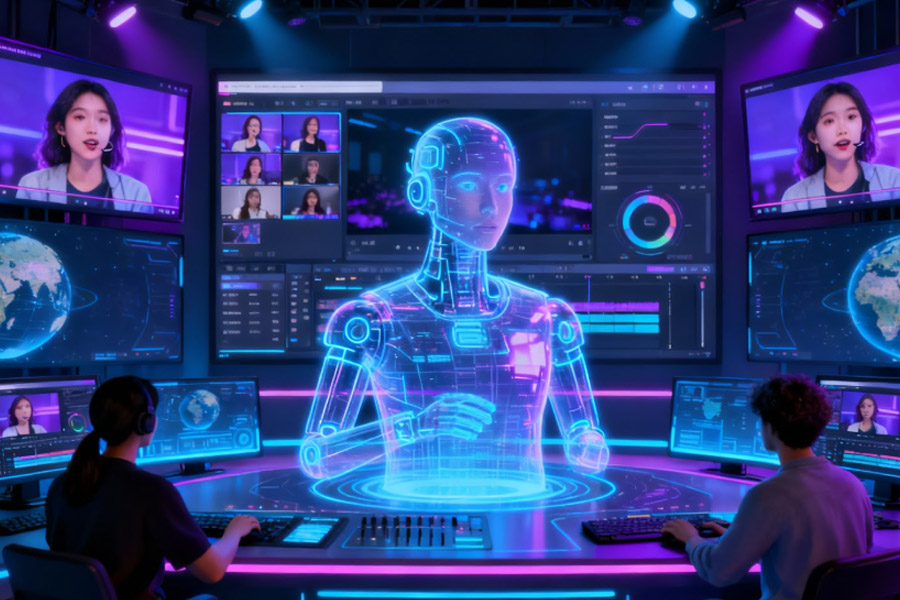
Artificial intelligence has quietly become a major part of how digital content is created today. From image generation to voice synthesis, AI tools are now deeply embedded in creative workflows. One area that has seen rapid development is facial animation, particularly technologies that animate lips, expressions, and interactions in videos.
Two technologies often discussed in this space are lip synchronization systems and AI-driven facial interaction generators. These tools are not limited to entertainment. They are increasingly used in education, research, digital art, and experimental media. This article offers a purely informational look at how these systems work, where they are used, and what challenges and responsibilities come with them.
Understanding Lip Sync AI
Lip sync AI refers to artificial intelligence systems designed to match mouth movements in a video with spoken audio. The primary goal is to ensure that speech looks natural and visually aligned with facial movement.
Modern tools such as: lip sync AI
demonstrate how lip sync AI analyzes speech patterns and converts them into realistic mouth movements.
This technology is commonly explored in animated characters, digital avatars, language dubbing projects, and educational simulations. Instead of manually animating facial movements, creators rely on AI models trained to understand how speech corresponds to facial motion.
How Lip Sync AI Works
Lip sync AI operates through a combination of audio processing and computer vision. The system first breaks speech into small sound units called phonemes. At the same time, it detects key facial points around the lips, jaw, and mouth.
Using trained machine learning models, the AI predicts how those facial points should move for each sound. These predictions are then rendered frame by frame, resulting in a video where speech and lip movement appear synchronized. While the process is automated, its accuracy depends heavily on the quality of the input audio and visuals.
What Is an AI Kissing Generator?
An AI kissing generator is a facial animation system that simulates kissing interactions between two faces. Unlike lip synchronization, this technology does not focus on speech. Instead, it concentrates on facial proximity, movement coordination, and interaction realism.
Examples such as: AI kissing generator
are often examined in discussions around digital storytelling, visual experiments, and facial motion research.
The purpose of these systems is to model how two faces move toward each other and respond naturally during close interaction. This makes them relevant for animation studies, digital art, and research into human expression.
Technology Behind AI Kissing Generators
AI kissing generators rely on multiple artificial intelligence techniques working together. Facial recognition models identify the structure and position of each face. Motion interpolation methods create smooth transitions between frames so movement appears fluid rather than mechanical.
In many cases, generative adversarial networks are used to improve visual realism. Three-dimensional facial mapping helps maintain proper depth and alignment, ensuring faces do not distort unnaturally during interaction. The result is a sequence of frames that simulate realistic facial movement.
Why Interest in These Technologies Is Growing
The growing attention around AI facial animation is closely tied to broader trends in digital media. AI-generated content has become more common across text, images, voice, and video. Facial animation naturally follows this progression.
At the same time, video-based communication dominates online platforms. This has increased interest in tools that simplify animation and visualization. Researchers, artists, and developers also explore these technologies to better understand realism, emotion, and how humans respond to AI-generated faces.
Practical Uses of Lip Sync AI
Lip sync AI plays a role in language localization by helping translated audio align more naturally with video. In education and training, animated instructors or avatars can present lessons in a more engaging way. Game developers use AI-assisted lip animation to reduce production time while maintaining visual quality. In accessibility research, visual speech representations can support hearing-impaired users.
Practical Uses of AI Kissing Generators
AI kissing generators are often used in digital art projects where creators want to animate still images. They are also useful in storytelling prototypes, allowing short emotional scenes to be visualized without full animation pipelines. Researchers studying facial expressions and interaction patterns use these tools to observe how AI interprets human movement.
Advantages of AI-Based Facial Animation
One of the main benefits of AI facial animation is automation. Tasks that once required frame-by-frame manual work can now be completed in minutes. These systems also scale well, allowing large volumes of content to be generated efficiently.
Cost reduction is another factor, as AI tools reduce dependence on motion capture equipment, actors, and studio environments. Lip sync systems also adapt more easily to multiple languages, which is especially useful in global content creation.
Limitations and Challenges
Despite their progress, AI facial animation tools still face limitations. Subtle emotional cues are not always accurately reproduced, which can make some animations feel unnatural. Output quality is highly dependent on the resolution and lighting of input images.
AI systems also lack true emotional understanding. They replicate patterns rather than interpret meaning. Additionally, high-quality rendering often requires strong computing resources, which may not be accessible to everyone.
Ethical and Privacy Considerations
Facial animation AI raises important ethical questions. Using someone’s face without permission can lead to privacy violations and misuse. There is also the risk of misleading content if AI-generated media is presented as real.
Responsible use involves obtaining consent, avoiding deceptive applications, and following legal and platform guidelines. Transparency is essential, especially as AI-generated visuals become more realistic.
The Future of AI Facial Animation
AI-driven facial animation is expected to improve steadily. Future developments may include more accurate emotional expression, real-time animation generation, and full head and body motion synthesis. Ethical safeguards are also likely to improve as awareness grows.
As these tools evolve, they may become standard components of digital media production and research rather than experimental technologies.
Conclusion
Lip sync AI and AI kissing generators represent meaningful progress in artificial intelligence-based video animation. While they are still developing and come with ethical responsibilities, their role in education, research, and digital creativity continues to expand.
Understanding how these technologies function, where they are applied, and what limitations they carry is essential as AI-generated media becomes more common. With responsible use and continued development, AI facial animation is likely to remain an important area of innovation in the years ahead.